Push Piers vs Helical Piers: Which Foundation Underpinning System Do You Need?
When a home's foundation settles unevenly, underpinning with deep steel pier systems is the gold standard for permanent stabilization. However, homeowners reviewing contractor proposals frequently encounter two competing technologies: hydraulic push piers and helical torque piers. Understanding the engineering differences ensures you choose the right system for your specific property.
Nashville Foundation Experts Engineering Team
Structural Foundation & Geotechnical Specialists
Direct Answer / Key Engineering Takeaway
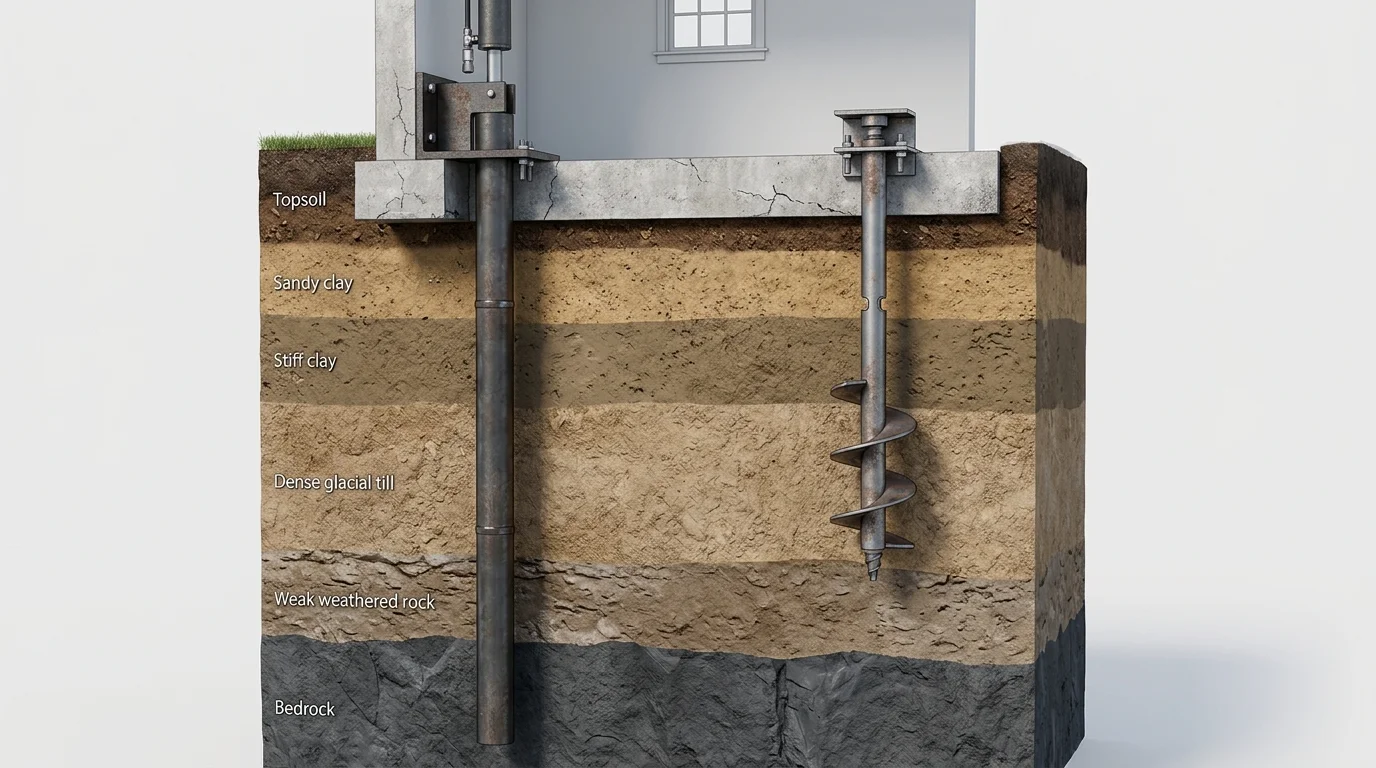
The choice between steel push piers and helical piers depends primarily on structural weight and depth to competent bedrock. Steel push piers utilize the weight of the building as hydraulic resistance to drive high-strength steel pipe sections deep through active soil until reaching refusal on solid limestone bedrock, making them ideal for heavier two-story brick and masonry homes. Helical piers feature spiral flight plates mechanically torqued into load-bearing soil layers independently of building weight, making them superior for lighter structures, porch additions, crawl space interior columns, and new construction.
The Engineering Goal of Deep Foundation Underpinning
Bypassing unstable topsoil to transfer loads onto competent bearing strata.
Foundation footings are originally poured near the surface in what geotechnical engineers call the active soil zone: the top 5 to 15 feet of soil subjected to weather changes, moisture fluctuations, and seasonal movement.
Underpinning involves driving structural steel columns deep beneath the footing into stable, non-moving strata. Once installed, heavy-duty steel brackets bolted to the footing transfer the building's weight directly to the piers, permanently isolating the house from surface soil shrinkage and swelling.
How Hydraulic Steel Push Piers Work
Resistance piers driven by hydraulic force against the building's own mass.
Steel push piers (also called resistance piers) consist of high-strength tubular steel pipe sections coated with rust-inhibiting galvanized finishes. An excavation is dug adjacent to the settled footing, and an engineered steel collar bracket is mounted beneath the concrete footing edge.
A hydraulic drive cylinder is attached to the bracket. Using the dead weight of the house as a physical reaction anchor, the hydraulic ram pushes interlocking steel pier sections straight down into the soil.
The pier continues downward through soft clays until it encounters unyielding load-bearing strata, typically solid limestone bedrock in Middle Tennessee. Because the driving force exceeds the structural weight of the home, the pier reaches true refusal, verifying its capacity to bear the house without further settling.
How Helical Torque Piers Work
Screw piers installed by rotational torque independent of building weight.
Helical piers consist of a central steel shaft fitted with one or more helically curved steel plates (bearing flights) resembling a giant corkscrew or auger.
Instead of being driven straight down by hydraulic push force, helical piers are screwed into the earth using a high-torque hydraulic drive head mounted on an excavator. As the pier rotates, the helical plates pull the shaft deep into dense soil layers.
The ultimate load-bearing capacity of a helical pier is directly proportional to the rotational torque required to drive it (measured in foot-pounds). Installers monitor torque gauges continuously to verify that the pier has reached the specified engineering capacity in dense subsoil, even if solid bedrock is not reached.
Side-by-Side Comparison: Push Piers vs Helical Piers
Key operational differences and suitability factors.
Choosing the appropriate system requires evaluating structure weight, installation constraints, and subsurface soil profiles.
Technical Comparison: Push Piers vs Helical Piers
| Factor | Hydraulic Push Piers | Helical Torque Piers |
|---|---|---|
| Drive Mechanism | Pushed straight down using hydraulic cylinders | Mechanically rotated into the ground via hydraulic torque motor |
| Reaction Force Required | Requires heavy building weight (dead load) as anchor | Independent of building weight; anchored by soil shear |
| Optimal Structural Type | Heavier structures: 2-story homes, full brick masonry veneers | Lighter structures: single-story frame homes, porches, additions, new builds |
| Target Depth & Refusal | Driven to true refusal on solid limestone bedrock | Torqued to engineered resistance in dense load-bearing soil or rock |
| Installation Footprint | Very compact; can install in tight crawl spaces or close lot lines | Requires mini-excavator access for torque drive motor |
| Lifting Capability | Exceptional lifting power for heavy masonry facades | Excellent for stabilization; moderate lifting capacity |
Geotechnical Selection Criteria in Middle Tennessee
Matching pier technology to local rock depth and soil strata.
Middle Tennessee's unique geology makes pier selection straightforward for experienced foundation specialists:
When Push Piers Are Recommended: In areas where limestone bedrock is reachable within 10 to 30 feet, such as downtown Nashville, Franklin, and Lebanon, and the home features a heavy brick facade or multi-story framing, push piers are generally the preferred solution. Driving to solid limestone bedrock provides definitive, uncompromised structural support.
When Helical Piers Are Recommended: For lightweight wooden structures, detached garages, sunroom additions, chimney supports, or interior crawl space columns where there is insufficient building weight to push a resistance pier, helical piers are the superior choice. They are also standard for pre-construction foundation support before new homes are built.
Frequently Asked Questions
Need An On-Site Structural Evaluation?
Speak directly with an experienced Middle Tennessee foundation specialist. We will discuss the symptoms you are observing and perform an on-site laser level elevation survey with zero travel fees.