Nashville Hub
Foundation Crack Repair in Nashville
High-pressure structural epoxy injection and flexible polyurethane sealants to stabilize shifting foundation walls and stop groundwater intrusion caused by urban clay movement.
Nashville properties face distinct structural challenges from expansive urban clay, Cumberland River alluvial silt, and historic brick and stone architecture. Whether stabilizing a Craftsman bungalow in East Nashville, reinforcing a bowing basement wall in Bellevue, or leveling crawl space floors in Donelson, we deliver engineered foundation solutions built for Davidson County soil.
23
ZIP codes served
Zero
On-site travel fees
Bedrock
Push pier stabilization
Historic
Masonry restoration
Explore our three primary service guides tailored specifically to Nashville housing styles and geotechnical conditions.
High-pressure structural epoxy injection and flexible polyurethane sealants to stabilize shifting foundation walls and stop groundwater intrusion caused by urban clay movement.
Specialized stone rubblestone and brick foundation restoration for historic East Nashville, Germantown, and downtown residential structures requiring period-appropriate lime mortar.
Restoration of sagging center girders, replacement of decayed wood sill plates, and adjustable crawl space support jacks for older Nashville crawl space foundations.
From century-old stone foundations near downtown to mid-century crawl spaces and steep hillside walkouts, repair strategies must reflect your home's specific era and terrain.
Late 19th and early 20th century Craftsman bungalows, Queen Anne, and Victorian homes in Lockeland Springs, Edgefield, and Germantown.
Unreinforced stone rubblestone and soft brick masonry footings sitting over dense urban clay. Historic lime mortar washouts and interior crawl space moisture induce progressive floor bounce and perimeter stair-step cracks.
Mid-century ranch residences, split-levels, and multi-story walkout basements built into rolling hillside topography.
Steep slope gravity creep and heavy lateral hydrostatic pressure against uphill foundation walls. Wet clay expansion forces foundation walls inward, creating horizontal mortar fractures and bowing block walls.
Post-war 1950s and 1960s single-family ranch homes built over vented crawl spaces with concrete block (CMU) stem walls.
High summertime relative humidity entering crawl space vents, creating wood rot on support girders and floor joists. Uneven soil moisture drying along exterior edges leads to dropped corner footings.
Dense neighborhood corridors blending historic cottages with substantial contemporary two-story infill construction.
Heavy modern building loads placed on clay building pads with variable moisture levels. Differential settlement occurs between newly poured garage additions and original structural footings.
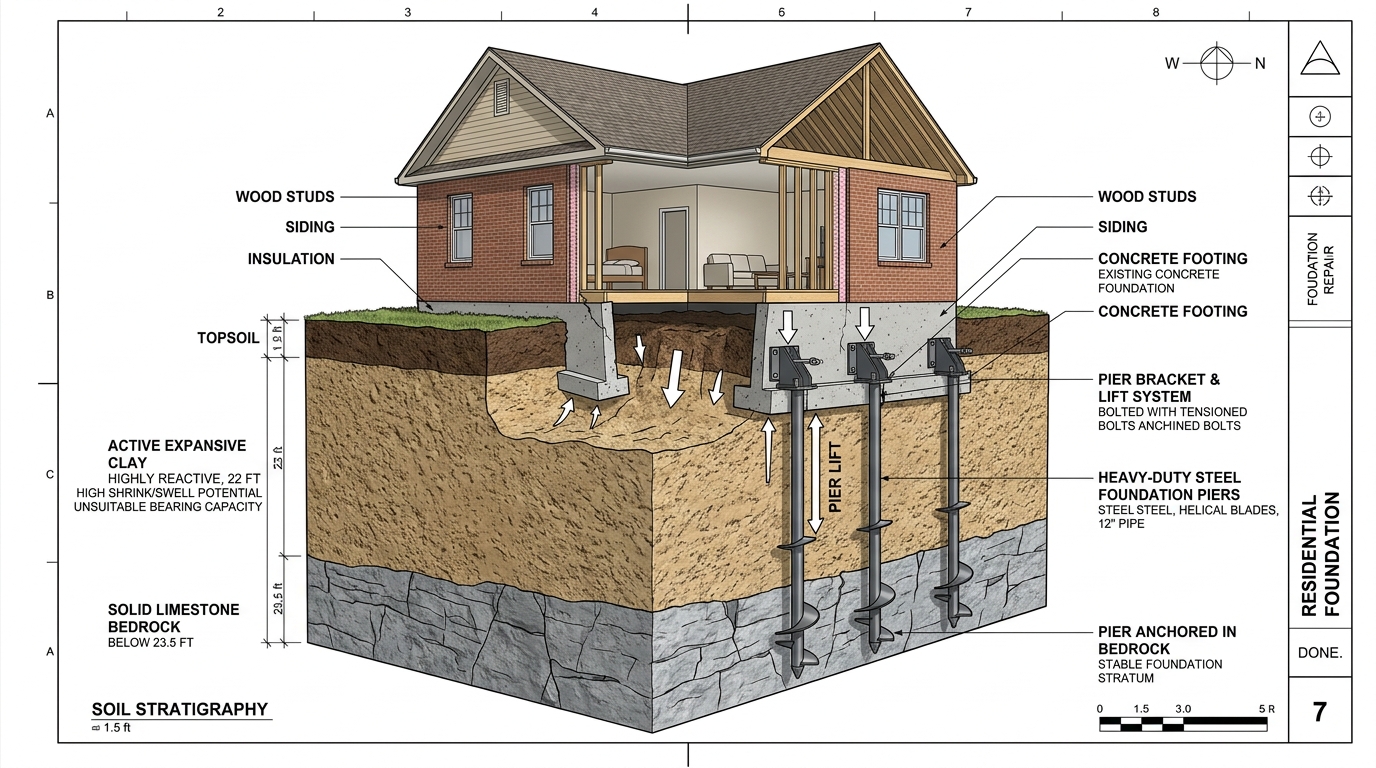
Nashville sits directly inside the Central Basin of Tennessee. Solid Ordovician limestone bedrock lies beneath the surface, but the soil layer above it consists of active smectite clay and river valley silt.
We provide prompt on-site foundation inspections throughout all 23 Nashville ZIP codes with zero travel fees.
Downtown / Riverfront
Midtown / Gulch / Music Row
12 South / Belmont / Melrose
Belle Meade / West End
East Nashville / Lockeland
North Nashville / Dickerson
Germantown / Buena Vista
Sylvan Park / The Nations
Woodbine / South Nashville
Crieve Hall / Tusculum / Antioch
Hillsboro Village / Vanderbilt
East Bank / Riverfront
Donelson / Hermitage
Green Hills / Forest Hills
Inglewood
Priest Lake / South Davidson
Bordeaux / Whites Creek
Central Business District
Oak Hill
Bellevue
MetroCenter
Vanderbilt Medical Corridor
East Airport / Percy Priest
Clear diagnostic answers with zero sales pressure. Here is what happens when our specialist arrives at your Nashville home.
We review doors that stick, drywall cracks, floor slope, and any water entry you have observed in your crawl space or basement.
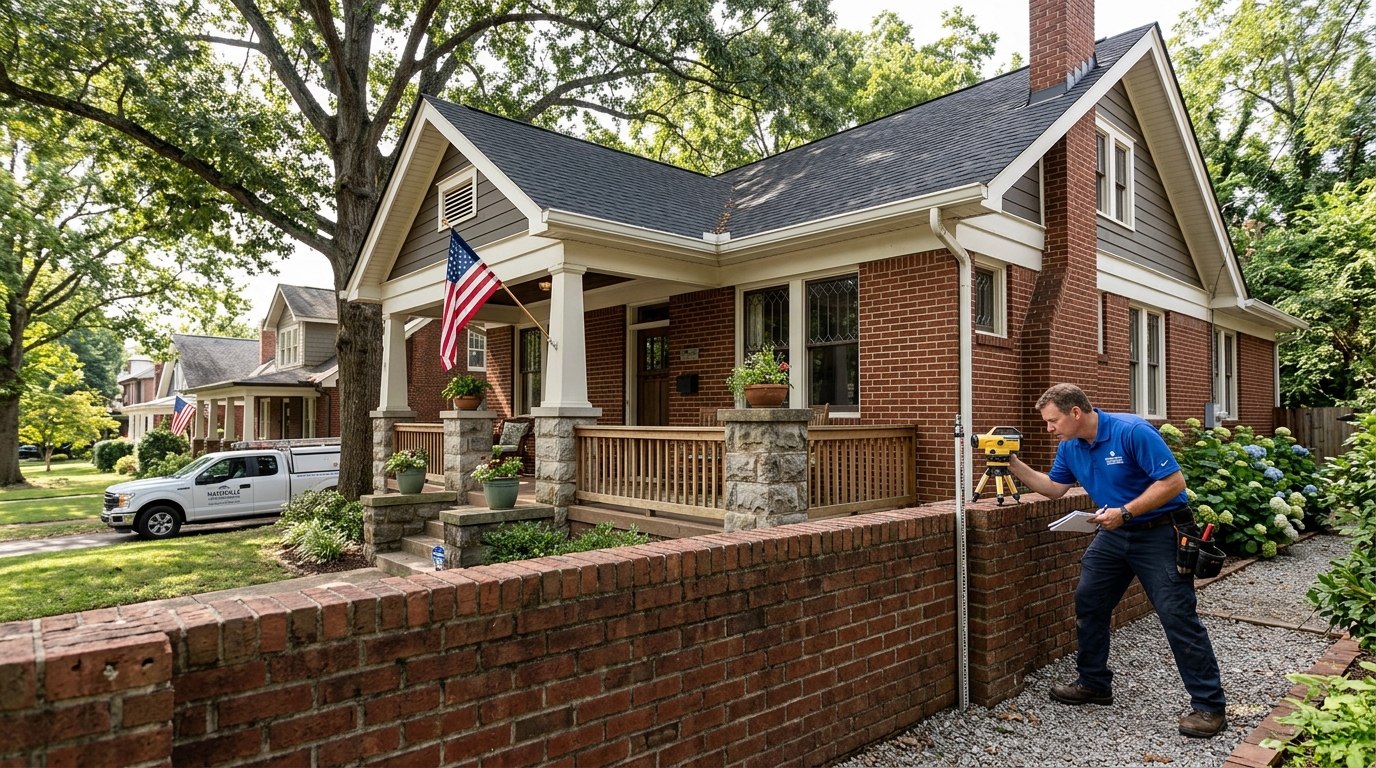
We inspect the foundation stem walls, exterior brick veneer, corner footings, gutter downspouts, and site drainage slope.
Using calibrated digital elevation instruments, we record precise floor elevation differences to identify structural settlement points.
You receive a clear, written assessment of the root cause, repair options, and structural methods with no high-pressure sales tactics.
Learn more about each engineered repair technique we perform across Davidson County properties.
Engineered repair for Nashville homes and commercial buildings.
Engineered repair for Nashville homes and commercial buildings.
Engineered repair for Nashville homes and commercial buildings.
Engineered repair for Nashville homes and commercial buildings.
Engineered repair for Nashville homes and commercial buildings.
Engineered repair for Nashville homes and commercial buildings.
Engineered repair for Nashville homes and commercial buildings.
Engineered repair for Nashville homes and commercial buildings.
Engineered repair for Nashville homes and commercial buildings.
Engineered repair for Nashville homes and commercial buildings.
Engineered repair for Nashville homes and commercial buildings.
Answers to common structural questions from Nashville and Davidson County property owners.
Nashville sits in the Central Basin of Middle Tennessee, where native clay soils contain high concentrations of smectite minerals. These clays expand heavily during rainy winters and shrink by up to 20 percent during hot summer dry spells. As the soil shrinks away from perimeter footings, corners drop. Additionally, homes near the Cumberland River deal with loose alluvial silt, while hillside homes in Bellevue and Oak Hill experience lateral soil pressure against basement walls.
Many older homes have slight architectural character from settling decades ago. Active foundation movement is distinguished by new or widening stair-step cracks through exterior brick mortar, doors that suddenly begin to rub against frames, separation between baseboards and hardwood floors, or cracks that reopen after being patched. An on-site elevation survey accurately measures current floor slope across your foundation.
Bellevue and Oak Hill feature steep slopes where houses are frequently cut into hillsides with walkout basements. The uphill soil creates significant lateral earth pressure. When clay soils become waterlogged during heavy spring rain storms, hydrostatic pressure multiplies against the uphill concrete block wall, pushing it inward and creating horizontal shear cracks along mortar joints.
Yes. When structural movement requires permit filings with the Metro Nashville Department of Codes and Building Safety, or when a home transaction requires a certified assessment, we collaborate with independent licensed structural engineers who can provide stamped engineering plans and repair verifications.
All 23 Davidson County ZIP codes qualify for our on-site structural inspections with zero travel charges. Whether your home is located in historic Lockeland Springs, West Meade, Bellevue, or Donelson, a foundation specialist visits your property directly.
You can call our local office directly or submit an inspection request through our contact page. We will discuss the specific structural symptoms you have observed, confirm your Nashville address, and schedule an on-site inspection with a foundation specialist.
Sticking doors, sloping floors, and stair-step mortar cracks are signs of foundation movement. Speak with a local Nashville specialist to review your property and arrange an on-site visit.
Zero travel charges across all 23 Davidson County ZIP codes. Honest evaluations and clear written options.