Masonry Foundation Repair in Nashville & Middle Tennessee
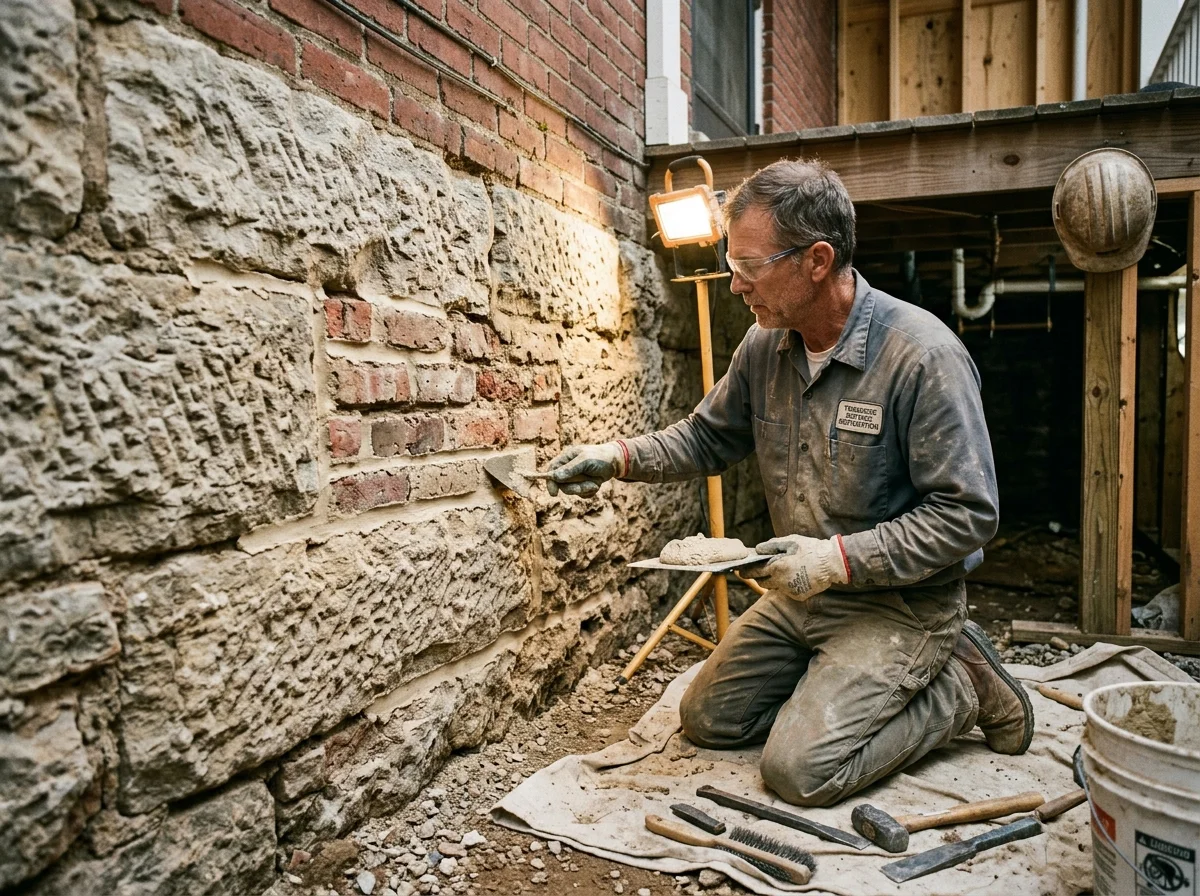
Historic stone, antique brick, and concrete block foundations require specialized structural care. Our masonry division pairs period-appropriate breathable lime mortar tuckpointing with modern carbon-fiber block stabilization, brick pier rebuilding, and moisture control to restore structural bearing capacity while preserving historic architectural integrity.
Vapor Permeable
Mortar Matching
Custom historic lime-based mortars prevent brick face spalling and moisture trap
Carbon-Fiber Grid
Block Stabilization
Aerospace-grade composite straps permanently halt concrete block wall deflection
Deep Footing
Pier Restoration
Rebuilt masonry piers paired with adjustable steel jacks on concrete pads
Period Correct
Historical Integrity
Preserves historic limestone and antique handmade brick structural authenticity
Signs Your Masonry Foundation Requires Restoration
Masonry decay accelerates when left untreated. Look for these warning signs across your basement walls, crawl space piers, and exterior foundation courses:
Stair-Step Cracks in Mortar Joints
Diagonal zigzag fractures running through mortar seams in brick or concrete block walls indicate differential soil settlement beneath foundation corners or perimeter grade beams.
Crumbling, Powdery, or Missing Mortar
Decades of groundwater wicking and high humidity dissolve calcium hydroxide in historic lime mortars, turning solid joints into loose sand and compromising wall strength.
Spalling, Flaking, or Popping Brick Faces
When previous repairs used hard, impermeable modern Portland cement over historic brick, trapped moisture freezes in winter, popping the decorative faces off antique bricks.
Bowing or Inward Leaning Block Walls
Hydrostatic soil pressure from expanding Middle Tennessee clay forces hollow concrete block (CMU) walls inward, creating continuous horizontal fractures along middle bed joints.
Tilting or Leaning Crawl Space Piers
Shallow brick or fieldstone support piers set on damp crawl space earth tilt sideways or settle into mud, causing bouncy floors, sloping hallways, and interior door sticking.
Efflorescence & Mineral Salt Encrustation
White, chalky mineral crusts on interior basement block or stone walls prove that groundwater is migrating through porous masonry, slowly leaching structural mortar binders.
Why Masonry Foundations Deteriorate in Middle Tennessee
Historic and concrete block foundations across Nashville face a combination of high precipitation, swelling clay, and natural material aging:
Expansive Clay Swelling & Hydrostatic Pressure
Middle Tennessee dense phosphatic clay soils absorb heavy seasonal rainfall, expanding with high lateral force against unreinforced brick, stone, and cinder block stem walls.
Groundwater Leaching & Mortar Dissolution
Historic foundations built before the 1940s utilized soft lime-and-sand mortars. Persistent water exposure leaches lime binders over decades, leaving behind unbonded, crumbly sand joints.
Incompatible Modern Portland Cement Patching
Smearing modern Type S or Type M Portland cement over historic handmade brick traps moisture. Because modern cement is harder than antique brick, temperature expansion destroys original masonry units.
Unreinforced Masonry Under Modern Dead Loads
Historic masonry foundations were built without internal steel rebar. As homes receive modern renovations like granite countertops and tile bathrooms, original unreinforced walls deflect under added dead load.
Our Core Masonry Foundation Restoration Approaches
We apply specialized engineering techniques matched to the age, material composition, and structural requirements of your foundation:
Historic Lime Mortar Tuckpointing & Repointing
Careful mechanical raking of deteriorated mortar followed by deep repointing using custom-formulated, vapor-permeable lime mortars (Type O, Type N, or natural hydraulic lime NHL).
- ✓Matches original historic mortar softness to protect antique brick and stone
- ✓Restores vapor breathability, allowing moisture to evaporate naturally
- ✓Deep joint packing re-establishes compressive load transfer across courses
- ✓Preserves historic architectural aesthetics in Nashville historic overlay districts
Concrete Block (CMU) Wall Structural Stabilization
Reinforcing deflected or cracked hollow cinder block foundation walls using high-tensile carbon-fiber grid straps, heavy-duty steel wall anchors, or structural epoxy injection.
- ✓Stops inward wall bowing caused by exterior hydrostatic soil pressure
- ✓Carbon-fiber straps bond directly to block faces with structural epoxy
- ✓Heavy-duty earth anchors allow incremental straightening in yard soil
- ✓Epoxy pressure injection seals sheared horizontal bed joints
Crawl Space Masonry Pier Rebuilding & Retrofitting
Reconstructing deteriorated brick or stone crawl space support piers, excavating deep poured concrete footings, and integrating commercial adjustable steel support jacks.
- ✓Replaces dry-stacked, leaning stone columns with reinforced masonry
- ✓Poured concrete footing pads bypass soft crawl space mud
- ✓Commercial galvanized steel posts allow precision floor re-leveling
- ✓Permanent load transfer eliminates bouncy, sagging interior subfloors
Hydrophobic Crack Sealing & Moisture Protection
Injecting expanding hydrophobic polyurethane resin into weeping masonry fissures and integrating sub-slab French drains to permanently relieve lateral water pressure.
- ✓Stops active water leaks through fractured mortar seams and block cores
- ✓Flexible polyurethane expands to fill voids while accommodating thermal movement
- ✓Eliminates the hydrostatic water table that causes mortar degradation
- ✓Integrates with crawl space vapor barrier encapsulation systems
Stabilizing Concrete Block (CMU) Walls Without Rebuilding
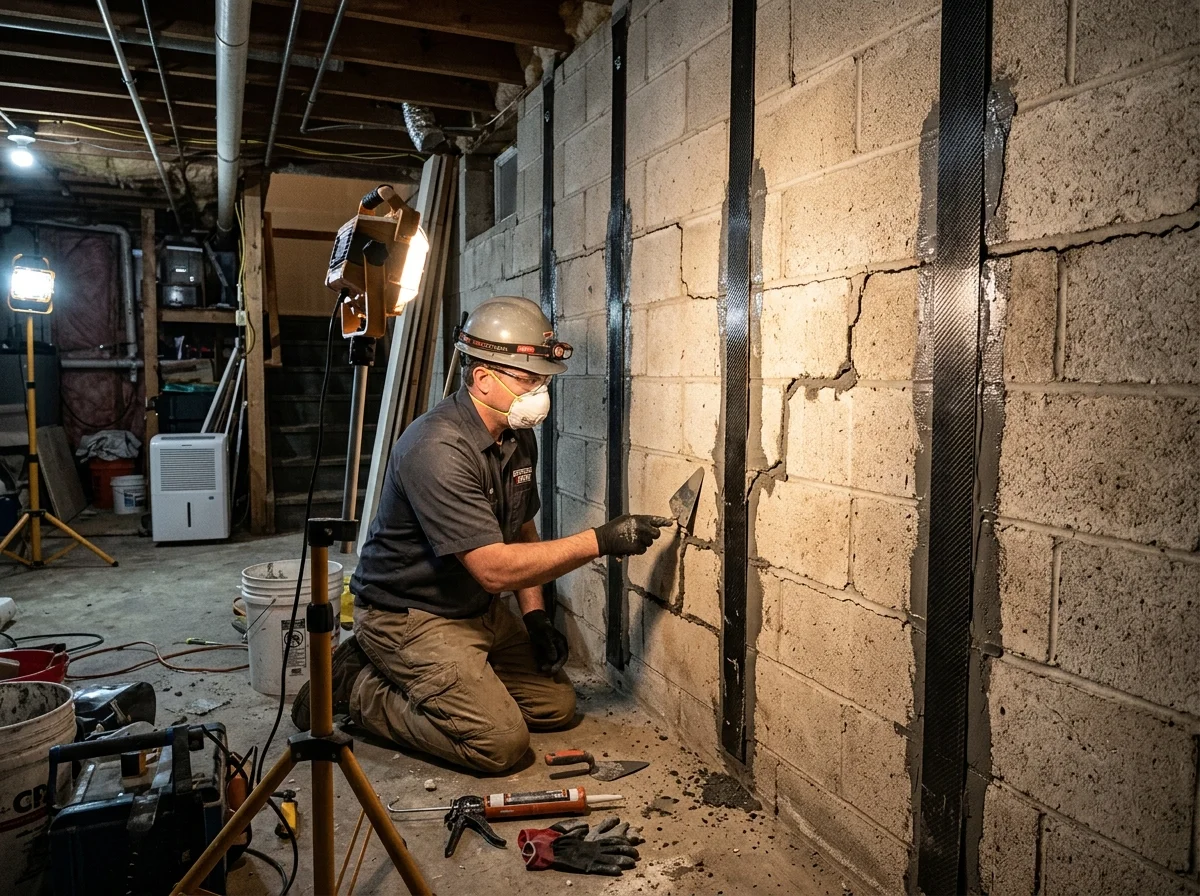
Hollow concrete masonry unit (CMU) cinder block walls were standard construction across Middle Tennessee from the 1940s through the late 1980s. When expansive clay pushes against unreinforced block walls, the masonry bows inward, shearing horizontal bed joints along the middle course.
Tearing down and re-pouring a basement foundation wall is disruptive, costly, and requires temporary house cribbing. Our engineered stabilization techniques save your original block walls with zero exterior excavation.
By pairing structural epoxy injection along sheared bed joints with aerospace-grade carbon-fiber grid reinforcement straps, we lock the blocks into an unyielding monolithic structure. The carbon-fiber system is ten times stronger than steel in tension, permanently preventing future wall deflection.
Masonry Restoration Methods Compared
Comparing historic preservation methods to modern shortcuts illustrates why vapor-permeable lime mortars and carbon-fiber reinforcement are essential:
| Performance Metric | Historic Lime Repointing (Recommended) | Modern Portland Cement | Carbon-Fiber Straps | Total Wall Rebuild |
|---|---|---|---|---|
| Mortar breathability & vapor flow | Highly vapor-permeable; allows trapped moisture to evaporate harmlessly | Completely impermeable; traps moisture inside soft brick, causing freeze spalling | Seals cracks internally while exterior drainage manages subgrade water | Pours new concrete, but destroys irreplaceable historic building fabric |
| Compatibility with soft historic brick | Engineered lower compressive strength protects fragile antique handmade clay bricks | Excessively hard; rigid cement crushes and shears softer historic brick edges | Non-destructive composite bonding distributes tensile loads across masonry | High structural risk during shoring and temporary house jacking operations |
| Preservation district compliance | Fully complies with historic zoning guidelines in Nashville, Franklin, and Davidson County | Violates historic preservation standards and leads to historic commission citations | Internal application preserves exterior historic masonry street view | Forbidden or strictly regulated in designated historic conservation overlays |
| Structural tensile reinforcement | Restores compressive bearing, but provides minimal tensile resistance against soil push | Creates brittle shear planes that crack along mortar lines under soil pressure | Provides immense tensile strength up to 10x stronger than structural steel | Provides high strength, but costs significantly more and takes weeks to cure |
| Disruption to living space | 100 percent external or crawl space work; zero interior home disruption | Exterior work, but triggers continuous ongoing brick face deterioration | Clean interior basement installation completed in a single working day | Extreme disruption; requires temporary shoring cribs, jacks, and interior gutting |
Our 8-Step Masonry Foundation Restoration Process
Every masonry restoration follows rigorous historical preservation guidelines, compatible material formulations, and precision structural stabilization:
Historical Masonry Audit & Mortar Hardness Testing
Our masonry specialists inspect the foundation, identifying masonry unit types (antique soft-fired brick, dressed limestone, or concrete block) and testing mortar hardness to formulate a compatible mix.
Precision Joint Raking & Debris Cleansing
Deteriorated mortar is carefully raked out to a uniform depth of 1/2 to 3/4 inch using non-impact oscillating tools and hand chisels, avoiding damage to fragile historic brick arrises.
Displaced Stone & Brick Realignment
Loose, shifted, or undermined stones and bricks are carefully extracted, cleaned of old debris, and reset in correct structural alignment using temporary shoring wedges as needed.
Custom Vapor-Permeable Lime Mortar Deep Repointing
Specially formulated lime-based structural mortar is packed into prepared joints in compact layers. Each lift is firmly thumb-printed before the next is applied, ensuring solid, void-free bonding.
Concrete Block Bed Joint Crack Sealing
For CMU block foundations, sheared bed joints and vertical stair-step cracks are injected with high-strength structural epoxy or hydrophobic polyurethane to re-bond separated block courses.
Carbon-Fiber Grid Strap or Wall Anchor Attachment
Where block walls exhibit inward bowing from hydrostatic clay pressure, high-tensile carbon-fiber straps or heavy steel wall anchors are secured to lock the wall permanently in place.
Crawl Space Pier Footing Excavation & Reconstruction
Tilting brick or stone crawl space piers are shored, excavated down to solid subgrade, repoured with reinforced concrete pads, and rebuilt with solid masonry and adjustable steel jacks.
Controlled Damp Curing & Final Structural Audit
Fresh lime mortar joints are protected with damp burlap misting to ensure optimal hydration and crack-free curing. We perform final elevation surveys and document completed structural work.
Signs Your Home Needs Masonry Foundation Repair
Mortar leaching and block deflection manifest throughout historic and older homes. Watch for these common symptoms:
Stair-Step Mortar Fractures Across Wall Faces
Diagonal stair-step cracks following mortar joints in brick or block foundations indicate that one corner or section of the footing is sinking into consolidating subgrade clay.
Crumbling or Powdering Mortar Joints
Mortar that you can scrape out with a key or your finger has lost its structural binders to moisture leaching, leaving unsupported bricks resting precariously on loose sand.
Spalled, Pitted, or Flaking Brick Surfaces
Bricks that crumble on the surface or pop off entirely have suffered freeze-thaw spalling, frequently caused by previous improper patching with impermeable modern Portland cement.
Horizontal Cracks and Inward Block Bowing
A horizontal crack along the third or fourth course of a concrete block basement wall indicates that exterior clay soil pressure is bowing the masonry inward.
Tilting or Sinking Brick Crawl Space Piers
Brick columns in the crawl space that lean out of plumb, show crushed mortar at their bases, or sink into mud compromise floor carrying girders and cause severe floor sag.
White Efflorescence Mineral Salt Crusts
Chalky white mineral salts on basement stone or block walls confirm active moisture migration that slowly erodes mortar joints and deteriorates foundation masonry.
Related Foundation & Structural Solutions
Masonry foundations often benefit from integrated structural stabilization, floor leveling, and moisture remediation:
Basement Wall Repair
Carbon fiber straps and heavy-duty steel wall anchors to stabilize masonry walls bowing inward from hydrostatic soil pressure.
Pier & Beam Repair
Complete crawl space leveling, sill plate replacement, and joist sistering to restore stability over settled masonry piers.
Foundation Waterproofing
Interior French drains and sump pump systems that relieve the hydrostatic groundwater pressure that erodes mortar joints.
Foundation Crack Repair
High-pressure structural epoxy and hydrophobic polyurethane injection to permanently seal leaking exterior foundation cracks.
Masonry Foundation Repair Across Middle Tennessee
We provide historic masonry restoration, brick tuckpointing, and block stabilization throughout all 12 counties in Greater Nashville:
Historic Masonry Foundation Repair in Nashville, TN
Period-appropriate lime mortar restoration, stone footing stabilization, and brick tuckpointing tailored specifically to historic East Nashville, Germantown, and historic Davidson County homes.
Masonry Foundation Repair Questions Answered
Clear engineering answers regarding historic lime mortar matching, block wall bowing, brick pier leveling, and preservation standards in Middle Tennessee:
Why should historic brick and stone foundations never be repaired with standard modern Portland cement?
Historic handmade bricks and local Nashville limestone were fired at lower temperatures than modern bricks, making them relatively soft and porous. They were originally laid with soft, flexible lime-based mortar. Modern Portland cement (Type S or Type M) is extremely hard, dense, and vapor-impermeable. When applied over historic masonry, it traps moisture inside the wall. During Tennessee winter freezes, trapped water expands and fractures the softer brick faces, a destructive process called spalling. Proper historic masonry restoration requires breathable lime-based mortars that match original hardness.
Can a bowing concrete block foundation wall be saved without tearing it down?
Yes. In the majority of cases, concrete block walls bowed inward by up to 2 inches can be permanently stabilized using high-tensile carbon-fiber reinforcement straps bonded with structural epoxy. For walls deflected beyond 2 inches, heavy-duty earth wall anchors or interior steel I-beam channel braces are installed to stabilize the wall and allow gradual straightening over time, eliminating the massive cost and disruption of complete wall replacement.
What causes stair-step cracks in brick and concrete block foundations?
Stair-step cracks occur when differential settlement stresses the foundation. In Middle Tennessee, heavy phosphatic clay soil shrinks during dry summer periods and swells when saturated in winter. When soil consolidates unevenly beneath one portion of the footing, the masonry wall experiences diagonal shear stress. Because mortar joints are naturally weaker than solid concrete blocks or hard stones, the crack follows the zigzag path of horizontal bed and vertical head joints.
How do you repair crumbling or shifting brick piers in a crawl space?
Our technicians temporarily shore the floor carrying girders using commercial hydraulic equipment to remove structural load from the failing pier. We dismantle unstable, dry-stacked, or crumbling brickwork, excavate down to solid subgrade soil, and pour a thick, reinforced concrete footing pad. The pier is then reconstructed using high-strength solid masonry and topped with an adjustable heavy-duty galvanized steel jack to restore level floors permanently.
Do your repairs comply with historic preservation guidelines in Nashville and Franklin?
Yes. We frequently work on historic properties throughout East Nashville, Germantown, Belmont-Hillsboro, 12 South, and historic downtown Franklin. Our masonry restoration protocols strictly adhere to the National Park Service Historic Preservation Briefs and local municipal historic zoning guidelines, utilizing period-appropriate natural hydraulic lime (NHL) mortars and non-destructive tuckpointing techniques.
How does proper drainage protect masonry foundations from future deterioration?
Water is the primary enemy of masonry foundations. Saturated clay soil exerts hydrostatic pressure that bows block walls, while continuous groundwater wicking dissolves mortar binders and triggers freeze-thaw spalling. Pairing masonry restoration with proper water management, such as sub-slab interior French drains, sump pump systems, and exterior downspout extensions, eliminates the water source and protects restored masonry for generations.
Schedule Your Free Masonry Foundation Inspection
Protect your historic brick, stone, or concrete block foundation from mortar decay, bowing walls, and structural settlement. Our masonry specialists provide comprehensive on-site evaluations, mortar hardness testing, and engineered restoration plans across Nashville and Middle Tennessee.
Serving Nashville, Franklin, Brentwood, Murfreesboro, Hendersonville, Mount Juliet, Lebanon, Columbia, and all surrounding Middle Tennessee historic communities.