Service Pillar Hub | Non-Destructive Slab Leveling
Concrete Slab Foundation Repair in Nashville & Middle Tennessee
Sunken, sloping, or cracked concrete slab foundations can undermine interior finishes, door operation, and plumbing systems. Our engineered slab repair solutions combine high-density geotechnical foam lifting and deep steel underpinning to restore unlevel floors, fill sub-slab voids, and stabilize settling foundations across Middle Tennessee without destructive demolition.
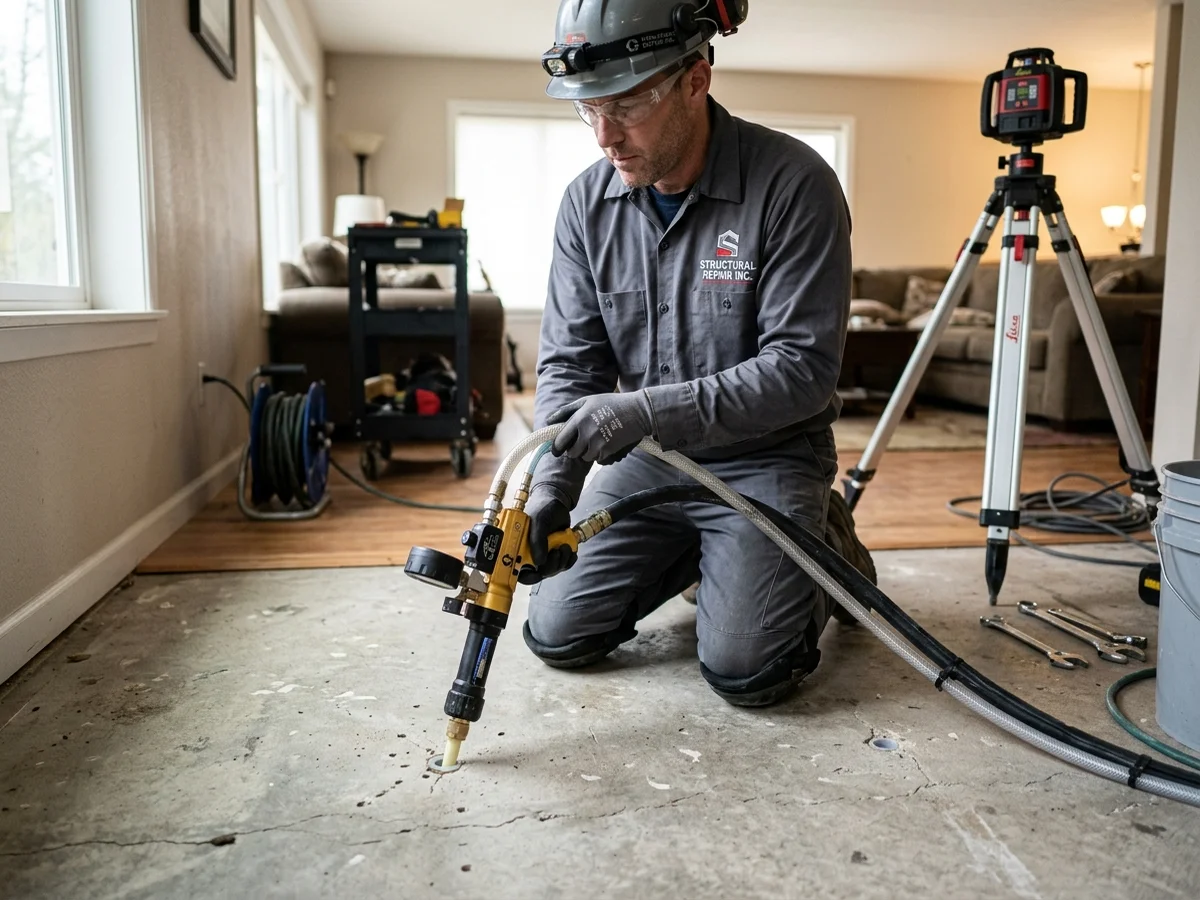
Precision geopolymer lifting: high-density structural polyurethane foam is injected through discrete 5/8-inch ports, expanding to fill voids and raise sunken concrete slabs to laser-measured level.
Warning Indicators
Common Signs of Concrete Slab Foundation Movement
Because slab foundations sit directly on the ground, subgrade soil instability manifests quickly throughout interior living areas. Recognizing these early warning signs helps prevent widespread damage.
Sloping or Uneven Interior Floors
A noticeable slope across a room, rolling marbles, or furniture that tilts indicates that the supporting soil beneath the slab has subsided or washed away.
Gaps Beneath Interior Baseboards
When a concrete slab drops downward, interior non-load-bearing partition walls remain suspended from ceiling framing, leaving visible gaps above the floor.
Cracked Ceramic Tiles & Concrete Fissures
Brittle floor finishes crack when the underlying concrete loses uniform subgrade support, causing continuous cracks to run across rooms and through grout joints.
Sticking Interior Doors & Twisted Jambs
Differential slab movement distorts interior wall framing, causing passage doors to bind against the head jamb or swing open unexpectedly.
Exterior Brick Veneer Separation
On monolithic slab-on-grade homes, perimeter grade beam settlement creates diagonal stair-step cracks in exterior masonry near corners and patio transitions.
Sub-Slab Plumbing Line Stress
Settling concrete slabs put severe shear stress on cast iron or PVC drain lines buried beneath the floor, often leading to recurring backups or leaks.
Middle Tennessee Geotechnical Context
Why Concrete Slabs Settle in Middle Tennessee
Middle Tennessee terrain features complex limestone karst geology overlaid by high-plasticity clay and uncompacted subdivision fill soils. These geological conditions create frequent subgrade settlement beneath slab-on-grade homes.
Uncompacted Subdivision Fill Soil
In fast-growing communities like Murfreesboro, Lebanon, and suburban Nashville, modern subdivisions are often built on deep cut-and-fill soil. When fill is not compacted to engineering standards, house weight causes progressive consolidation over several years.
Expansive Clay Swell-Shrink Cycles
Middle Tennessee soil contains high concentrations of expansive clay minerals. Heavy winter rains cause the clay to swell upward, while severe summer droughts cause it to shrink away, leaving unsupported voids beneath the concrete slab.
Sub-Slab Plumbing Leaks & Washout
A pinhole leak in a pressurized supply line or a cracked drain pipe can silently wash away granular bedding gravel and native soil, creating subterranean caverns that allow slabs to collapse downward.
Mature Tree Root Desiccation
Large oak, maple, and hickory trees near a slab foundation draw hundreds of gallons of moisture from the ground during dry months, shrinking the clay beneath the foundation perimeter faster than in open yard areas.
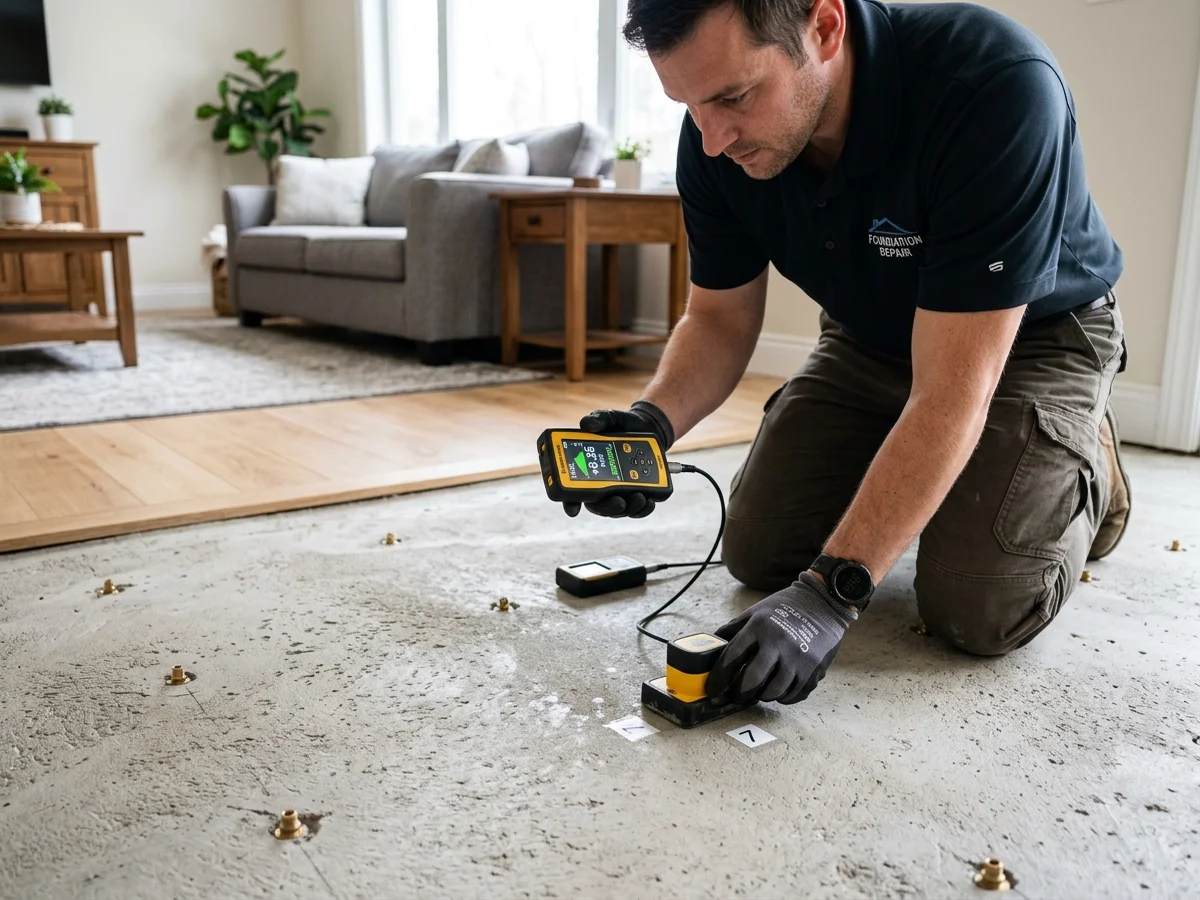
Sub-slab diagnostic survey: digital elevation sensors detect millimeter floor variances and locate subterranean void zones beneath residential living areas before lifting begins.
Engineered Methods
Slab Foundation Repair Technologies
Every slab settlement case is unique. We match the structural repair method to the exact depth of soil movement and structural load requirements.
High-Density Polyurethane Foam Lifting
Precision geopolymer injection through penny-sized ports with zero interior demolition
High-density expanding geotechnical foam is injected beneath settled concrete through discrete 5/8-inch ports. The two-part polymer expands rapidly, densifying loose subgrade soils, filling subterranean voids, and lifting the sunken slab back toward its original elevation in minutes.
Best Suited For:
Interior sunken slabs, unlevel living areas, garage floors, and void filling beneath concrete.
End-bearing steel piers driven to limestone bedrock for exterior load-bearing grade beams
When perimeter grade beams or structural load-bearing walls of a monolithic slab settle, steel push piers are hydraulically driven through unstable soils down to solid limestone bedrock. Heavy-duty slab brackets transfer the building weight onto rock, permanently halting foundation settlement.
Applied when structural grade beams experience deep settlement
Deep Soil Polymer Permeation
Deep-injection void consolidation to compact weak soil layers and stop recurring subsidence
For deeper soil instability, injection tubes are driven several feet beneath the slab into loose fill strata. Low-viscosity polyurethane binds granular soil particles into a dense, load-bearing composite mass that permanently resists water erosion and future compaction.
Best Suited For:
Deep fill settlement, plumbing washout cavities, and loose aggregate beneath heavy floor loads.
Applied when structural grade beams experience deep settlement
Method Comparison
Polyurethane Foam Lifting vs. Mudjacking vs. Slab Replacement
Comparing structural polymer injection to traditional concrete slurry lifting and complete slab demolition.
Repair Factor
Polyurethane Foam (Polyjacking)
Traditional Mudjacking
Total Slab Replacement
Injection port diameter
5/8 inch (penny-sized hole); easily patched to match tile grout or bare concrete
1.5 to 2 inches (soda-can size); requires large unsightly concrete patches
Complete floor demolition; requires jackhammering and total slab removal
Weight added to weak soil
Ultra-lightweight (3 to 5 lbs per cubic foot); adds virtually zero overburden
Extremely heavy (100 to 120 lbs per cubic foot); often causes secondary settlement
Heavy new concrete pour over identical unstable subgrade soil
Curing time & usability
Achieves 90 percent structural strength in 15 minutes; immediate room use
Requires 24 to 48 hours to dry before furniture or traffic can be restored
Requires 7 to 28 days for concrete curing, moisture testing, and flooring
Water & erosion resistance
Hydrophobic closed-cell polymer; completely immune to water, rot, and erosion
Slurry mixture of topsoil, clay, and cement that can wash away with moisture
New concrete remains vulnerable if underlying soil washouts continue
Homeowner disruption
Clean hose-fed process; no interior dust, no demolition debris, and quiet work
Messy slurry pumps, heavy hoses, high water runoff, and cleanup inside the home
Massive dust, jackhammer noise, structural framing shoring, and dumpster staging
Void filling precision
Expands in all directions, penetrating microscopic soil fissures beneath the slab
Heavy slurry flows only toward the path of least resistance, leaving air pockets
Subgrade must be re-compacted manually in tight interior residential quarters
Injection port diameter
Polyurethane Foam:
5/8 inch (penny-sized hole); easily patched to match tile grout or bare concrete
Mudjacking:
1.5 to 2 inches (soda-can size); requires large unsightly concrete patches
Slab Replacement:
Complete floor demolition; requires jackhammering and total slab removal
Weight added to weak soil
Polyurethane Foam:
Ultra-lightweight (3 to 5 lbs per cubic foot); adds virtually zero overburden
Mudjacking:
Extremely heavy (100 to 120 lbs per cubic foot); often causes secondary settlement
Slab Replacement:
Heavy new concrete pour over identical unstable subgrade soil
Curing time & usability
Polyurethane Foam:
Achieves 90 percent structural strength in 15 minutes; immediate room use
Mudjacking:
Requires 24 to 48 hours to dry before furniture or traffic can be restored
Slab Replacement:
Requires 7 to 28 days for concrete curing, moisture testing, and flooring
Water & erosion resistance
Polyurethane Foam:
Hydrophobic closed-cell polymer; completely immune to water, rot, and erosion
Mudjacking:
Slurry mixture of topsoil, clay, and cement that can wash away with moisture
Slab Replacement:
New concrete remains vulnerable if underlying soil washouts continue
Homeowner disruption
Polyurethane Foam:
Clean hose-fed process; no interior dust, no demolition debris, and quiet work
Mudjacking:
Messy slurry pumps, heavy hoses, high water runoff, and cleanup inside the home
Slab Replacement:
Massive dust, jackhammer noise, structural framing shoring, and dumpster staging
Void filling precision
Polyurethane Foam:
Expands in all directions, penetrating microscopic soil fissures beneath the slab
Mudjacking:
Heavy slurry flows only toward the path of least resistance, leaving air pockets
Slab Replacement:
Subgrade must be re-compacted manually in tight interior residential quarters
Dedicated Technical Guide
Want to learn more about expanding polyurethane foam lifting?
Read our in-depth engineering breakdown of high-density polyjacking injection and void filling.
How Concrete Slab Foundations Are Professionally Repaired
A controlled, non-destructive workflow designed to restore slab elevations with zero demolition.
1
Precision Laser Elevation Survey
Our technician conducts a room-by-room laser elevation survey, mapping floor levels across every room to pinpoint high points, settlement troughs, and pitch variations down to the millimeter.
2
Sub-Slab Void & Plumbing Assessment
We assess the slab for subterranean voids, inspect plumbing leak records, and verify whether the movement is confined to interior floating floors or extends to perimeter load-bearing grade beams.
3
Penny-Sized Port Placement
Technicians drill discrete 5/8-inch ports at engineered intervals across the settled slab. Holes can often be placed in tile grout lines, closet corners, or carpet seams to minimize visual impact.
4
Controlled Geotechnical Foam Injection
Specialized injection guns deliver high-density structural polyurethane beneath the slab. The polymer expands rapidly, filling underground voids and consolidating weak subgrade soils.
5
Real-Time Laser Lift Monitoring
As the expanding foam develops lifting force, continuous laser sensors monitor floor elevation. Technicians control the rise with precision, bringing the concrete smoothly back to level.
6
Flush Port Sealing & Clean Finish
Injection ports are removed, and the small drill holes are patched with matching structural cement or colored grout. The entire work area is swept clean, and rooms are immediately ready for normal living.
Can a sunken concrete slab be leveled without jackhammering or removing floors?
Yes. High-density polyurethane foam lifting (polyjacking) is a non-destructive repair method performed entirely through discrete 5/8-inch ports. The expanding foam lifts the slab from beneath, eliminating the need to jackhammer concrete, carry out heavy rubble, or replace finished interior flooring.
What is the difference between polyurethane foam lifting and traditional mudjacking?
Traditional mudjacking pumps a heavy slurry of soil, limestone, and cement through large 2-inch holes. This heavy slurry adds hundreds of pounds of weight to already weak soil, which frequently causes the slab to sink again later. Polyurethane foam weighs only 3 to 5 pounds per cubic foot, requires tiny penny-sized holes, cures in 15 minutes, and will never wash out or degrade.
How do I know if my concrete slab has settled or if the soil is heaving?
Settlement occurs when subgrade soil compacts or washes out, causing the slab to drop downward and pull away from interior baseboards. Soil heave happens when expansive clay absorbs extreme moisture and pushes the center of the slab upward (doming), causing doors to rub against the floor. A professional laser elevation survey reveals whether the floor has dropped or domed.
Why do concrete slab foundations settle so frequently in Murfreesboro and Middle Tennessee?
Rapid residential growth across Middle Tennessee has led to extensive subdivision construction on hillsides and valleys requiring cut-and-fill grading. In areas like Murfreesboro, uncompacted fill soil combined with native smectite clay swell-shrink cycles often leads to slab movement within the first 5 to 15 years after construction.
Can sub-slab plumbing leaks cause a concrete floor to sink?
Yes. A concealed plumbing leak under a concrete slab foundation continuously saturates the supporting soil, eroding granular base gravel and washing out fine soil particles. As an underground cavity forms, the unsupported concrete slab cracks and sinks under the weight of walls, furniture, and flooring.
How long does polyurethane slab repair take and how soon can the room be used?
Most residential slab lifting projects are completed in a single day. Because geotechnical polyurethane foam achieves 90 percent of its structural load capacity within 15 minutes of injection, homeowners can walk on the floor, move furniture back into place, and resume normal living immediately after our crew finishes.
Schedule an On-Site Slab Foundation Assessment
Speak directly with a local foundation specialist. We will measure your floor elevation, evaluate sub-slab void conditions, and explain whether non-destructive foam lifting is the right engineered solution for your home.