Murfreesboro Hub
Slab Foundation Repair in Murfreesboro
Engineered polyurethane foam lifting, void filling, and steel underpinning for settled concrete slab foundations over uncompacted subdivision fill in Rutherford County.
Murfreesboro properties face distinct structural challenges driven by rapid subdivision construction over deep cut-and-fill soil, reactive smectite clay, and pervasive concrete slab-on-grade foundations. Whether restoring a sunken living room slab with high-density polyurethane foam in Blackman or stabilizing exterior grade beams with bedrock push piers in Barfield, we deliver permanent, engineered solutions designed specifically for Rutherford County terrain.
5
ZIP codes served
Zero
On-site travel fees
Slab & Poly
Precision foam lifting
Bedrock
Steel push piers
Explore our two primary service guides focused specifically on Rutherford County residential architecture and geotechnical ground movement.
Engineered polyurethane foam lifting, void filling, and steel underpinning for settled concrete slab foundations over uncompacted subdivision fill in Rutherford County.
Precision polyfoam concrete raising to eliminate trip hazards, restore negative slopes, and level sunken driveways, sidewalks, patios, and garage floors.
From contemporary slab master-planned communities in Blackman to historic masonry residences near the downtown square, structural solutions must account for neighborhood building age and local subsoil compaction.
Master-planned suburban subdivisions, multi-level single-family homes, and modern two-story residences built on slab foundations after 2000.
Graded over cut-and-fill terrain where subsoil was placed over natural depressions. Deep clay fill consolidates unevenly beneath structure weight, causing interior partition gaps, dished slabs, and cracked tile floors.
Contemporary residential developments, newer craftsman communities, and transitional acreage homes along the southern Rutherford County corridor.
Variable clay depths over shallow Ordovician limestone strata. Prolonged summer heat desiccates expansive clay around footing perimeters, resulting in diagonal drywall cracks and binding exterior doors.
Established family neighborhoods, contemporary multi-section subdivisions near Compton Road, and homes along Stones River tributaries.
Alluvial river basin silts and moisture-sensitive smectite clay. High seasonal water table fluctuations alternate between soil saturation and drought shrinkage, exerting cyclic movement on perimeter grade beams.
Historic brick residences, mid-century bungalows near the historic square, university-corridor rental properties, and older crawl space homes.
Unreinforced brick and stone masonry footings resting on native surface soils without modern drainage. Decades of rainwater runoff and seasonal soil movement lead to mortar breakdown and bouncing interior floor spans.
Rutherford County has been one of the fastest-growing residential markets in the Southeastern United States. Developing large subdivisions across undulating terrain required mass earthmoving, filling in low-lying drainage swales and ravines to create level building pads.
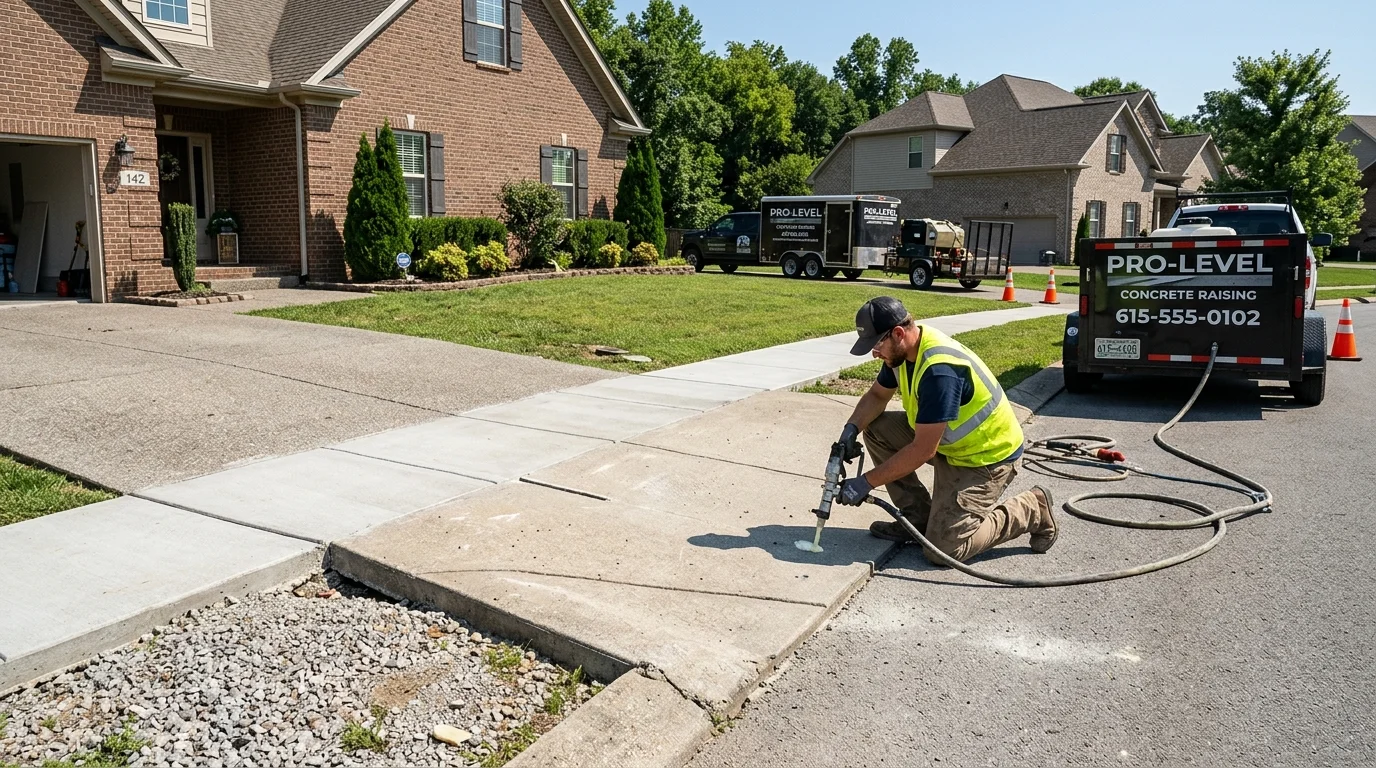
In master-planned communities across Rutherford County, exterior concrete flatwork frequently settles faster than the main foundation. Settling driveway panels, dropped front entry walkways, and uneven garage aprons create tripping hazards and funnel rainwater directly toward your foundation stem wall.
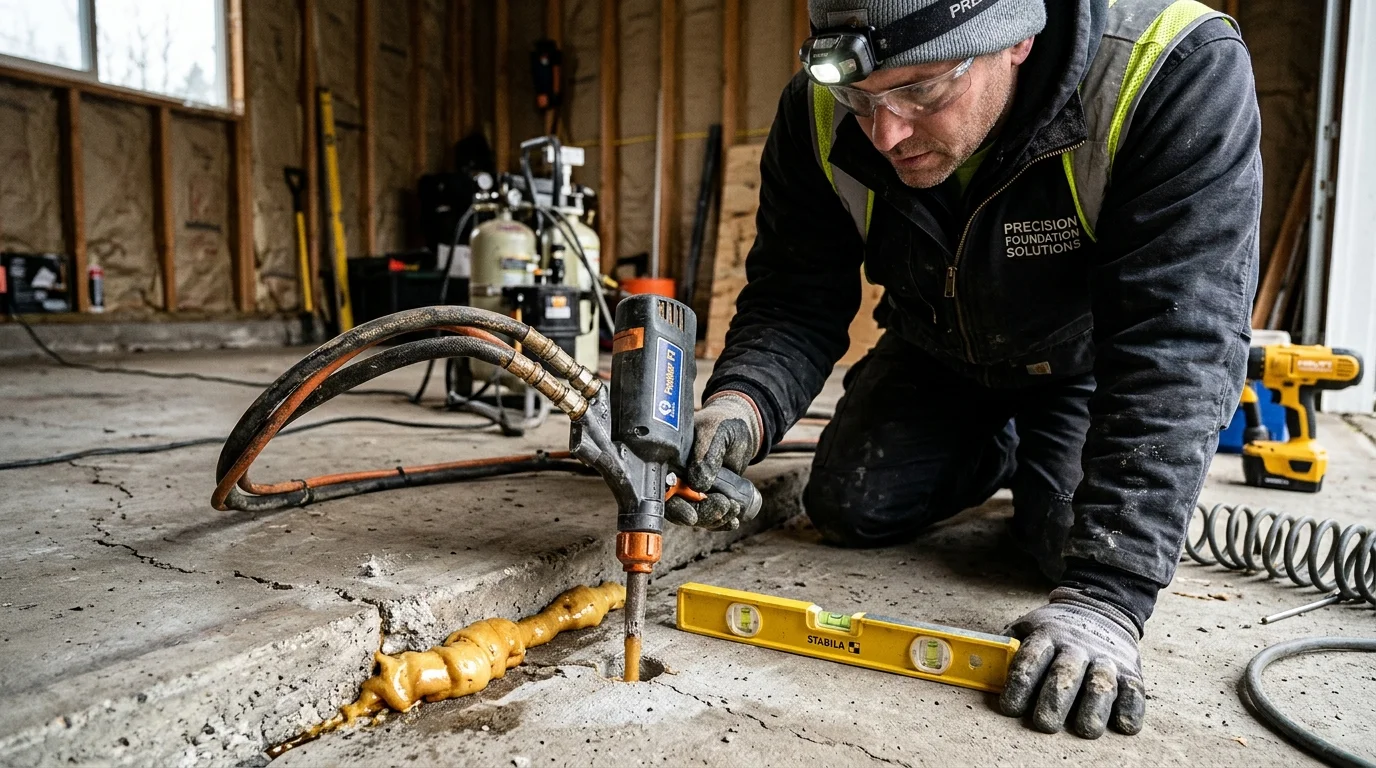
Traditional mudjacking pumps heavy slurry through large 2-inch holes, adding dead weight over already fragile subdivision subsoil. Our high-density structural polyurethane weighs approximately four pounds per cubic foot, requires only tiny 5/8-inch ports, will never wash away in heavy rain, and cures for immediate vehicle traffic in fifteen minutes.
Sunken panels often create a negative slope that directs water toward the foundation footing. By raising the concrete back to its intended elevation, we restore positive drainage away from the home while eliminating uneven joint edges.
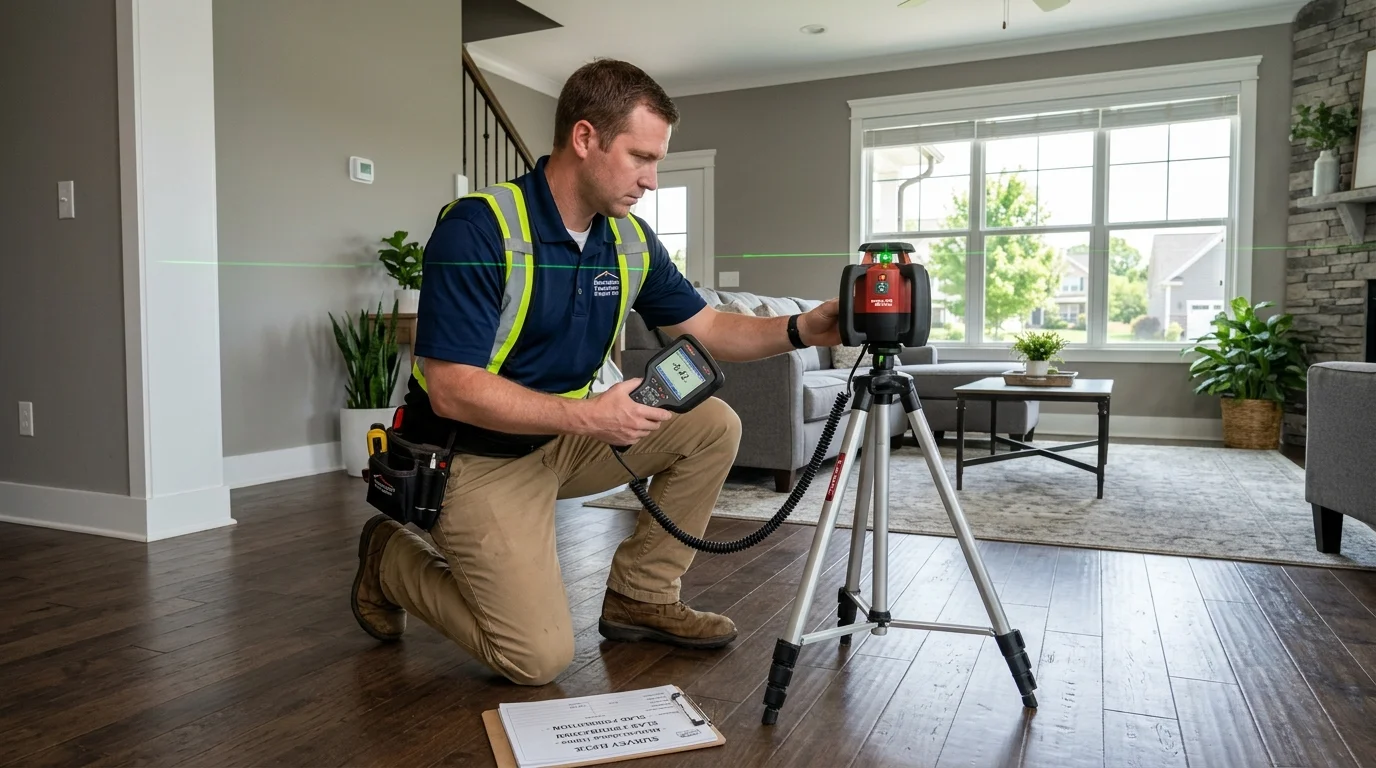
We provide on-site foundation evaluations and laser elevation surveys throughout all five Murfreesboro ZIP codes with zero travel fees.
Objective structural information with zero sales pressure. Here is what to expect when a specialist visits your Murfreesboro property.
We review doors that stick, floor slope, tile cracks, and any visible separation between baseboards and the concrete slab.
We examine exterior brick veneer, foundation stem walls, control joints, downspout drainage, and driveway flatwork.
Using calibrated digital elevation instruments, we record elevation variations across your floor plane to quantify settlement.
You receive a clear, written explanation of root cause and customized repair options with no high-pressure tactics.
Explore our full range of 11 engineered foundation repair, slab stabilization, and moisture management solutions.
Engineered repair for Murfreesboro residential and commercial structures.
Engineered repair for Murfreesboro residential and commercial structures.
Engineered repair for Murfreesboro residential and commercial structures.
Engineered repair for Murfreesboro residential and commercial structures.
Engineered repair for Murfreesboro residential and commercial structures.
Engineered repair for Murfreesboro residential and commercial structures.
Engineered repair for Murfreesboro residential and commercial structures.
Engineered repair for Murfreesboro residential and commercial structures.
Engineered repair for Murfreesboro residential and commercial structures.
Engineered repair for Murfreesboro residential and commercial structures.
Engineered repair for Murfreesboro residential and commercial structures.
Clear answers to common slab foundation, settlement, and concrete leveling questions from Rutherford County homeowners.
Murfreesboro has experienced rapid subdivision growth over the past three decades. Many residential communities were built over rolling terrain that required deep cut-and-fill grading. When fill dirt, often comprised of native Rutherford County clay, is placed without optimal moisture control or compacted below structural density standards, it gradually consolidates under the dead weight of the house. Combined with severe Middle Tennessee summer dry spells that shrink clay soils, interior slab sections settle downward, creating hollow pockets underneath.
Key warning signs include noticeable floor slopes, interior doors that rub the frame or will not latch, cracks running through ceramic floor tiles along control joints, gaps opening between baseboards and the floor surface, and drywall cracks radiating diagonally from interior door headers and window corners. You may also notice a hollow sound when walking across settled areas of the floor.
Polyurethane foam lifting, also known as polyjacking, is an engineered, minimally invasive repair method. Technicians drill dime-sized 5/8-inch ports through the concrete slab or flooring grout lines. A high-density structural polymer is injected beneath the slab. As the liquid components react, they expand into a dense, closed-cell foam that fills subterranean voids, consolidates loose sub-base fill, and gently lifts the concrete back to its engineered elevation. The material cures fully within fifteen minutes.
Traditional mudjacking pumps a heavy mixture of water, clay, sand, and cement through large 2-inch holes. That slurry adds hundreds of pounds of dead weight onto already weak, uncompacted subsoil, which often leads to re-settlement in Rutherford County. In contrast, high-density polyurethane weighs only about four pounds per cubic foot, will not wash out in rainy seasons, requires tiny 5/8-inch injection ports, and cures almost immediately.
No. All five Murfreesboro ZIP codes (37127, 37128, 37129, 37130, and 37132) are inside our core Middle Tennessee service area. Our comprehensive on-site foundation evaluations and elevation surveys carry zero travel charges and zero inspection fees.
Yes. When the exterior concrete grade beam or perimeter footing of a slab foundation settles due to deep soil movement, hydraulically driven steel push piers are installed beneath the footing. Heavy-duty brackets attach to the reinforced grade beam, and steel pier sections are driven through active clay fill until reaching solid Ordovician limestone bedrock. The structure is then permanently stabilized and lifted.
Middle Tennessee features smectite clay soils with high shrink-swell plasticity. During extended dry spells in July, August, and September, clay soils lose moisture and contract significantly. As soil shrinks away from perimeter foundation footings, support is removed, causing corner settlement, foundation wall cracks, and separation between concrete flatwork and the house.
Call our local team directly or submit your details through our contact page. A structural specialist will discuss the symptoms you are seeing, confirm your Murfreesboro property location, and arrange a convenient on-site structural elevation survey.
From master-planned subdivisions in Blackman and Overall Creek to established neighborhoods near downtown Murfreesboro and Barfield, speak directly with a local specialist to schedule your on-site foundation or concrete evaluation.
Zero on-site travel charges across 37127, 37128, 37129, 37130, and 37132. Honest evaluations and clear written options.