Commercial Foundation Repair in Nashville & Middle Tennessee
Differential settlement and unstable warehouse slabs threaten commercial facility safety, material handling equipment, and operational productivity. Our commercial division delivers high-tonnage steel underpinning, precision geotechnical foam slab stabilization, and deep subgrade void filling engineered to restore structural capacity with minimal business disruption.
High Tonnage
Pier Capacity
Commercial structural steel piles engineered for massive commercial dead loads
High Density
Subgrade Injection
Geotechnical polyurethane expands to densify loose sub-slab soil and fill voids
15 to 30 Min
Cure Duration
Rapid polymer cure allows immediate resumption of forklift and equipment traffic
Solid Limestone
Bedrock Bearing
Steel push and helical piers driven to verified refusal on Middle Tennessee bedrock
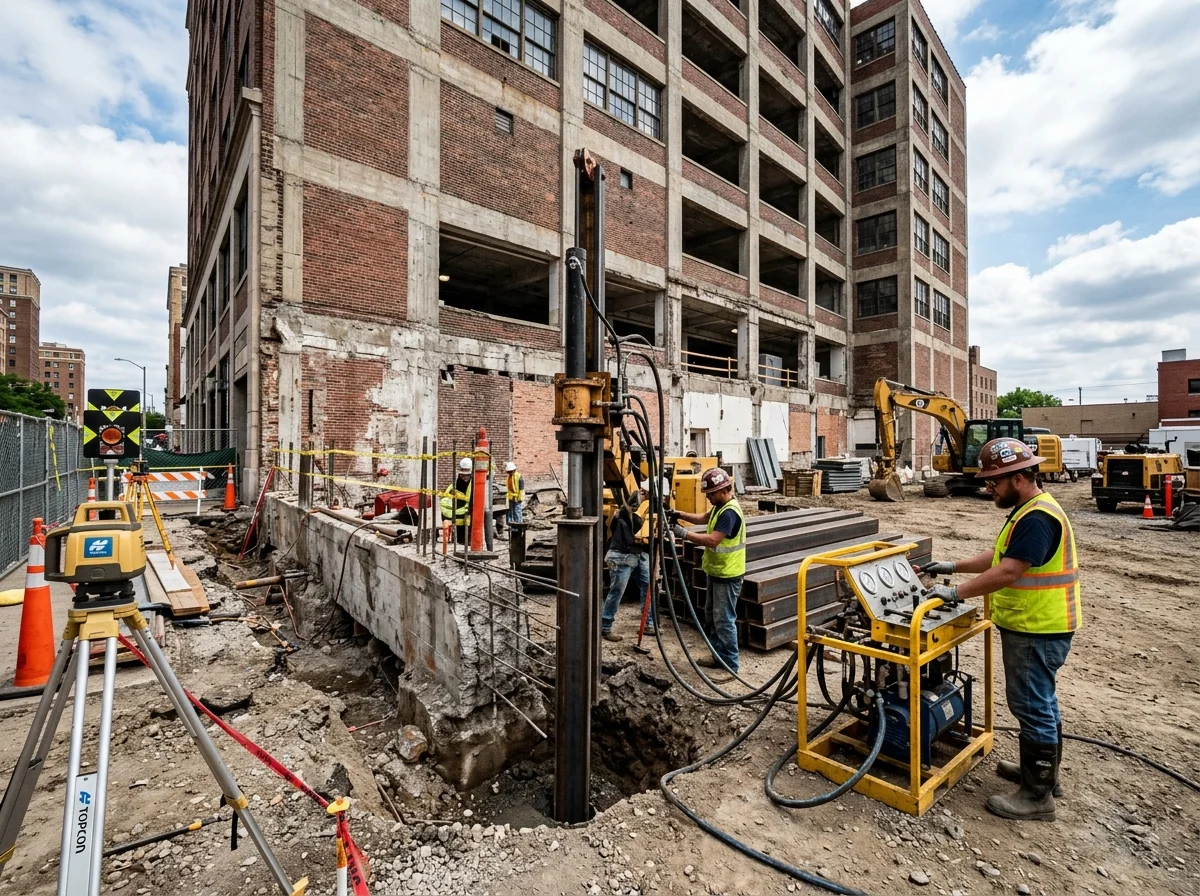
Signs of Commercial Foundation & Slab Distress
Commercial structural movement compromises building safety, damages material handling machinery, and creates severe liability issues. Identify these critical warning signs:
Uneven Warehouse Floor Joints & Rocking Slabs
Settlement at expansion joints creates tripping hazards and uneven bumps that jolt forklifts, damage palletized inventory, and accelerate material handling equipment wear.
Exterior Masonry & Tilt-Up Panel Cracking
Stair-step fractures through concrete masonry units (CMU), separation at tilt-up panel caulk joints, and diagonal shear cracks near building corners indicate differential footing settlement.
Sticking Commercial Overhead & Dock Doors
When perimeter grade beams or loading dock slabs subside, commercial rolling overhead doors rack out of square, bind in their tracks, or fail to seal against weather.
Separation Around Loading Dock Levelers
Heavy repeating dynamic loads from delivery trucks cause dock pit slabs to settle, creating dangerous gaps between dock leveler curb angles and the warehouse floor.
Gaps Beneath Interior Steel Support Columns
Isolated spread footings supporting structural steel columns sink into soft subgrade, causing gaps at baseplates, ceiling truss deflection, and interior partition wall shearing.
Sub-Slab Soil Voids & Cavity Formation
Underground plumbing leaks, roof drainage washouts, or uncompacted fill consolidation create hollow air pockets beneath commercial slabs, leading to sudden floor panel collapse.
Why Commercial Foundations Settle Across Middle Tennessee
Commercial properties face unique stresses combining massive dead loads, repeating industrial machinery vibrations, and Central Tennessee complex soil conditions:
Intense Dynamic Machinery & Forklift Wheel Loads
Industrial facilities, distribution centers, and manufacturing plants subject concrete slabs to continuous high-pressure point loads from loaded forklifts, reach trucks, and heavy production equipment.
Deep Cut-and-Fill Soils in Logistics Corridors
Modern industrial parks across Antioch, Murfreesboro, Lebanon, and Mount Juliet were graded over deep cut-and-fill soil. Inadequately compacted fill consolidates unevenly under building weight.
Subgrade Clay Saturation & Storm Drainage Runoff
Middle Tennessee experiences over 50 inches of annual precipitation. Vast commercial roof expanses generate high water volumes that saturate perimeter soils, weakening bearing capacity beneath footings.
Karst Limestone Voids & Subsurface Dissolution
Central Tennessee karst geology features subterranean limestone solution channels. Soil erosion into underlying cavities deprives commercial spread footings and grade beams of uniform support.
Our Core Commercial Foundation Solutions
We engineer specialized deep underpinning and geotechnical void filling solutions tailored to commercial, industrial, and multi-family specifications:
Commercial Underpinning
Heavy-capacity steel push piers and large-diameter helical piles driven to verified load-bearing refusal on solid limestone bedrock. Engineered to stabilize multi-story commercial grade beams and column footings.
- ✓Individually load-tested to verified commercial safety factors
- ✓Hydraulic synchronized manifolds allow controlled structural lifting
- ✓Bypasses unstable upper soils to anchor directly in bedrock
- ✓Negligible vibration preserves sensitive building operations
Warehouse Slab Stabilization
High-density geotechnical expanding polyurethane foam injection (polyjacking) through dime-sized ports. Fills subgrade voids, densifies weak soils, levels sunken floor panels, and cures in under 30 minutes.
- ✓Fast 15 to 30-minute cure avoids costly facility downtime
- ✓High compressive strength easily withstands heavy forklift traffic
- ✓Small 5/8-inch injection holes preserve warehouse floor aesthetics
- ✓Hydrophobic polymer resists groundwater washouts and erosion
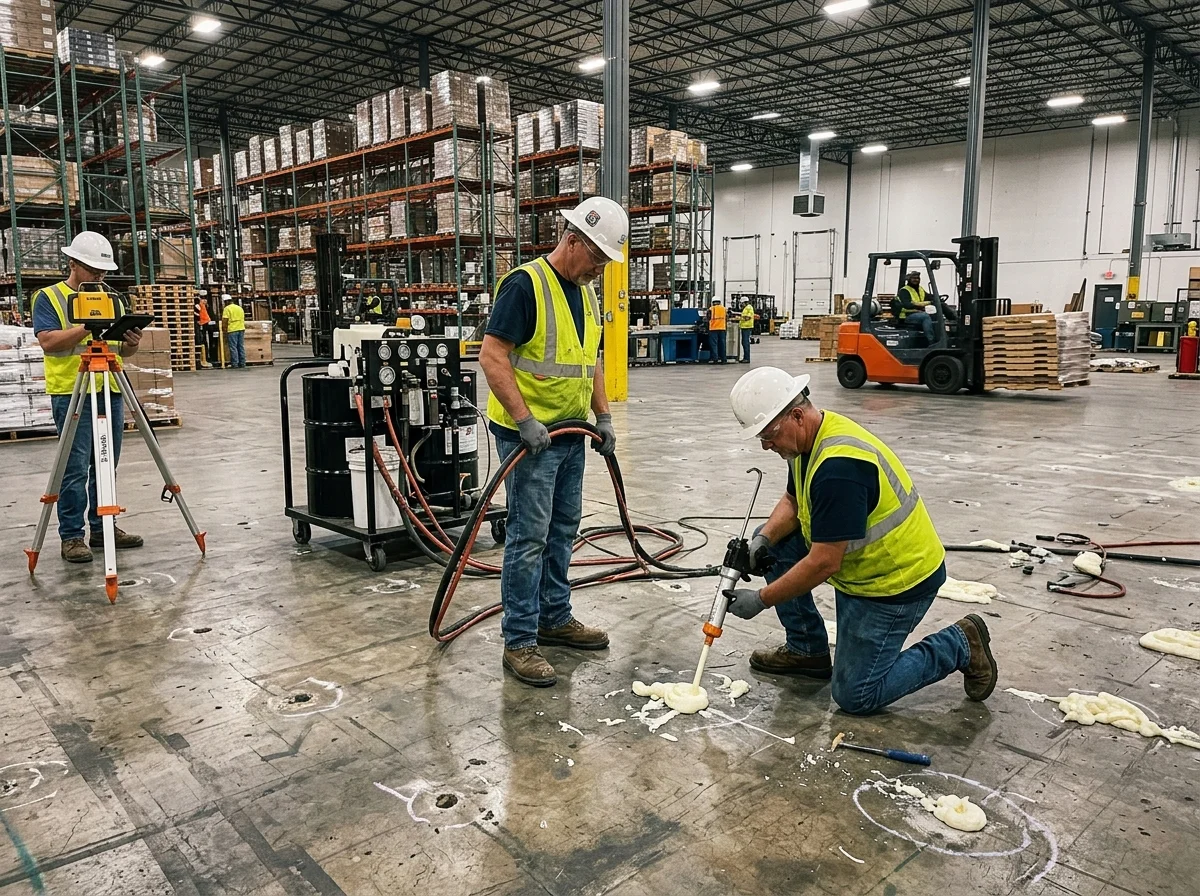
Zero Facility Downtime: The Polyurethane Advantage
Traditional concrete floor repair requires shutting down warehouse bays, jackhammering old concrete, and waiting 28 days for new slabs to achieve design strength. For active logistics facilities, 3PL warehouses, and manufacturing plants, this downtime results in severe revenue loss.
Our high-density geotechnical polyurethane injection process resolves slab settlement without facility interruption. Technicians drill small 5/8-inch ports directly through the concrete floor and inject an expanding, hydro-insensitive polymer.
As the two-part polymer expands with tremendous force, it fills sub-slab voids, consolidates weak underlying soil, and gently lifts settled slab panels back to uniform grade. The material achieves 90 percent full structural strength within 15 minutes, allowing forklifts and machinery to resume traffic immediately.
Commercial Repair Methods Compared
Comparing structural underpinning, geotechnical foam injection, and traditional slab replacement clarifies the optimal engineered approach for commercial facilities:
| Feature | Commercial Underpinning | Warehouse Foam Injection | Mudjacking Slurry | Slab Demolition & Repour |
|---|---|---|---|---|
| Primary engineering role | Deep structural stabilization for heavy grade beams and column footings | High-density foam injection to fill voids and level commercial floor panels | Slurry pumping using heavy water, cement, and topsoil mixture | Complete demolition, excavation, and re-pouring of commercial slab panels |
| Operational downtime | Performed from exterior or interior perimeter with zero plant shutdown | Immediate return to service within 15 to 30 minutes after injection | Requires 24 to 48 hours of curing before light traffic is permitted | Weeks of downtime for concrete saw-cutting, removal, pouring, and 28-day curing |
| Weight added to subgrade | Zero weight added to weak soil; loads transferred directly to bedrock | Ultralight polymer adds only 3 to 5 pounds per cubic foot to soil | Extremely heavy grout adds 100 to 120 pounds per cubic foot, stressing weak soil | Replaces heavy slab with another heavy slab over the same uncompacted soil |
| Long-term settlement resistance | Permanent; steel columns bear directly on solid Middle Tennessee limestone | Permanent; closed-cell polymer will not degrade, wash out, or shrink | Prone to recurrent settlement as organic slurry washes away from moisture | High risk of re-settlement unless deep underlying soil failure is stabilized |
| Drill port footprint | Excavated bracket pockets backfilled and restored cleanly | Virtually invisible 5/8-inch holes patched flush with color-matched polymer | Large 2-inch core holes leave conspicuous round scar patches across floors | Complete destruction of finished flooring, joints, and subfloor utilities |
Our 8-Step Commercial Foundation Repair Protocol
Commercial projects require rigorous engineering oversight, verified load telemetry, and certified quality documentation from initial site assessment to final lockoff:
Structural Engineering Review & Load Calculations
Our commercial foundation specialists review structural building plans, calculate dead and live column loads, assess laser elevation surveys, and examine geotechnical soil boring logs.
Precision Utility Locating & Ground Prep
Ground-penetrating radar (GPR) and private utility marking locate sub-slab conduits, post-tension cables, and plumbing lines to ensure safe excavation and drilling.
Footing Excavation & Grade Beam Bracket Mounting
For underpinning, small access pockets are excavated along footings or column pads. Heavy-gauge commercial structural steel brackets are mounted flush to the concrete.
Hydraulic Manifold Driving to Bedrock Refusal
Commercial steel push piers or large-diameter helical piles are driven deep into the ground using synchronized hydraulic equipment until reaching engineering refusal on solid limestone.
Synchronized Structural Lifting & Mechanical Lockoff
Multiple hydraulic cylinders lift the building simultaneously, eliminating stress concentrations. Steel collar assemblies lock the piers permanently in place to hold design elevation.
Deep Polyurethane Injection & Subgrade Densification
For settled warehouse slabs, specialized delivery guns inject two-part expanding geotechnical foam through 5/8-inch ports, expanding with high force to fill subgrade voids and lift floor slabs.
Laser Elevation Verification & Joint Realignment
Continuous laser monitors track floor movement down to millimeter precision, realigning uneven expansion joints and verifying proper slopes across loading dock aprons.
Port Patching, Cleanout & Engineering Documentation
Injection holes are patched flush with high-strength cementitious or epoxy grout. Our team delivers comprehensive completion reports, hydraulic log records, and structural documentation.
Related Commercial & Structural Solutions
Commercial facilities often require comprehensive solutions addressing water intrusion, wall retention, and exterior pavement stabilization:
Concrete Leveling
Precision lifting for exterior commercial sidewalks, apron transitions, loading bays, and ADA walkways to eliminate trip hazards.
Foundation Waterproofing
High-capacity interior pressure-relief French drains and commercial sump systems to manage subterranean groundwater in commercial basements.
Basement Wall Repair
Commercial carbon-fiber grid matrix systems and heavy-duty earth tiebacks to secure retaining walls and deflected subgrade masonry.
Foundation Inspection
Comprehensive commercial structural assessments, laser elevation surveys, and diagnostic reporting for property acquisitions and leasing.
Commercial Foundation Repair Throughout Middle Tennessee
We provide commercial underpinning and industrial slab stabilization services across all primary logistics and commercial corridors in Greater Nashville:
Commercial Foundation Repair Questions Answered
Clear engineering answers regarding facility downtime, pier load capacities, warehouse joint stabilization, and code compliance in Middle Tennessee:
Will commercial foundation repair or slab leveling disrupt our daily business operations?
Our methods are specifically engineered to minimize or completely eliminate facility downtime. High-density geotechnical polyurethane foam injection cures within 15 to 30 minutes, allowing forklifts, trucks, and production lines to resume normal traffic immediately. For commercial underpinning, our compact hydraulic equipment operates within small exterior or interior access footprints, allowing retail, office, and warehouse facilities to remain open and fully functional throughout the repair.
How do commercial foundation repairs differ from residential repairs?
Commercial structures carry significantly higher dead loads, dynamic live loads (such as heavy machinery and high-mast forklifts), and larger spans than residential homes. Commercial repairs require heavier wall-thickness steel piers, high-tonnage drive brackets, deeper subgrade geotechnical foam formulations with higher compressive strength ratings, and strict adherence to structural engineering plans, OSHA standards, and municipal commercial building codes.
What causes warehouse floor slabs to rock or sink at expansion joints?
Warehouse floor slabs frequently experience joint rocking due to void formation beneath the concrete. Heavy repeating wheel loads from forklifts traveling across joints flex the slab edges. Over time, this pumping action pulverizes and displaces sub-base soil, creating air pockets beneath the joint. Without uniform subgrade support, one slab drops relative to the other, creating joint deflection that jolts equipment and damages concrete edges.
Can deep geotechnical foam injection support heavy warehouse pallet racking?
Yes. Our commercial-grade geotechnical polyurethane foams are engineered with compressive strengths ranging from 6,000 to 14,000 pounds per square foot or higher. When injected beneath concrete slabs, the expanding polymer travels into porous soil voids, compacts loose fill, and forms a dense, hydro-insensitive structural foundation capable of easily supporting high-bay pallet racking, multi-tier mezzanines, and industrial manufacturing machinery.
How do steel push piers and helical piles reach refusal in Middle Tennessee?
Middle Tennessee geology features massive, competent limestone bedrock beneath variable depths of clay and gravel overburden. During commercial underpinning, our hydraulic equipment drives heavy-wall steel pier sections downward until the drive pressure reaches engineered refusal (typically 4,000 to 10,000+ psi hydraulic pressure), proving that the pier has reached unyielding bedrock. This direct mechanical contact ensures zero future settlement under building weight.
Do you work with property managers, general contractors, and structural engineers?
Yes. We regularly collaborate with commercial property managers, facility directors, general contractors, and third-party structural engineers across Middle Tennessee. We provide detailed geotechnical site reviews, hydraulic drive logs, certified load calculations, and laser elevation documentation to verify that all structural work complies strictly with project design specifications.
Schedule a Commercial Foundation Engineering Consultation
Protect your commercial investment from structural settlement, tripping hazards, and facility downtime. Our commercial specialists provide on-site laser surveys, structural evaluations, and engineered repair plans across Nashville and Middle Tennessee.
Serving Nashville, Franklin, Brentwood, Murfreesboro, Hendersonville, Mount Juliet, Lebanon, and all surrounding Middle Tennessee commercial centers.