Commercial Underpinning in Nashville & Middle Tennessee
Permanently stabilize settling commercial grade beams, column pads, and structural perimeter walls. Our heavy-capacity commercial underpinning systems utilize thick-wall steel push piers and high-torque helical piles driven directly to Middle Tennessee limestone bedrock, paired with synchronized hydraulic manifold lifting to restore elevation with zero facility shutdown.
Up to 100+ Tons
Pier Capacity
Engineered heavy-wall structural steel piles rated for high commercial loads
High-Yield Steel
Casing Material
Heavy industrial tube sections engineered to resist buckling and shear
Limestone Bedrock
Bearing Strata
Driven to verified hydraulic refusal directly on competent bedrock
Synchronized
Lift Precision
Multi-cylinder hydraulic manifolds lift grade beams without torsional stress
Why Commercial Grade Beams & Column Footings Settle
Commercial buildings impose continuous dead loads and severe dynamic forces that overwhelm unstable overburden soils across the Greater Nashville region:
Massive Concentrated Column Reactions
Commercial buildings concentrate hundreds of thousands of pounds of structural dead load and dynamic machinery vibrations onto isolated spread footings and perimeter grade beams.
When underlying soils experience seasonal moisture fluctuations or fill consolidation, footings settle differentially. Even a half-inch of settlement at a critical column can cause severe structural racking, binding overhead crane rails, jamming glass doors, and cracking masonry.
Deep Fill Consolidation & Karst Limestone Subgrade
Commercial developments in areas such as Antioch, Murfreesboro, Mount Juliet, and Lebanon frequently occupy sites graded over deep cut-and-fill terrain.
Heavy seasonal rainfall from Middle Tennessee 50-plus inches of precipitation softens fill soils, while karst limestone dissolution channels allow fine soil particles to migrate into subterranean voids. Underpinning bypasses these unstable layers completely to bear on solid limestone.
Components of an Engineered Commercial Underpinning System
Our commercial underpinning installations utilize industrial-grade structural components engineered to meet demanding commercial building codes and load requirements:
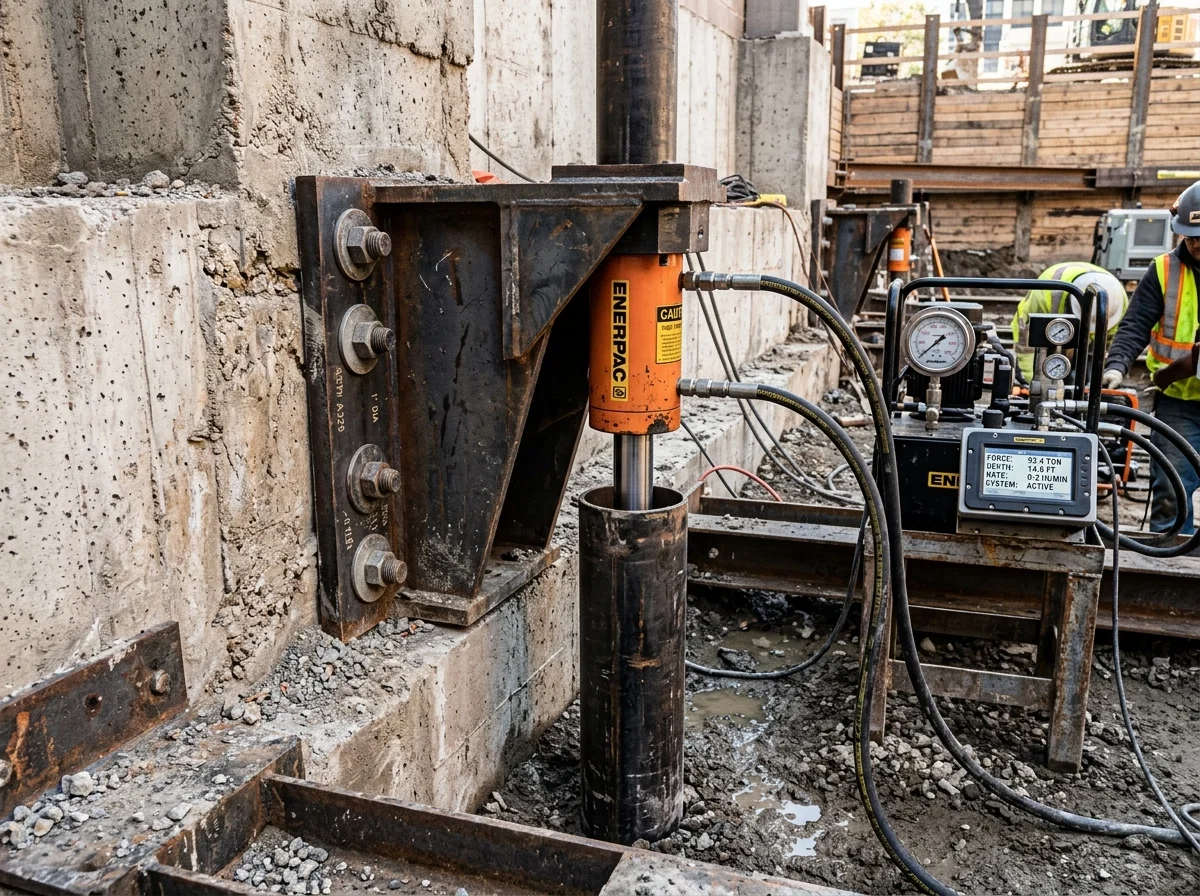
Heavy-Gauge Structural Steel Underpinning Brackets
Fabricated from high-strength structural plate steel, our commercial brackets mount directly beneath grade beams, column pads, or load-bearing footings. Secured with heavy mechanical anchor bolts, they transfer massive building dead and live loads safely into the pier column.
Thick-Wall High-Yield Steel Pier Sections
Our commercial steel push pier tubes feature significantly thicker wall dimensions and larger outer diameters than residential systems. Driven deep through unstable clay overburden, the interlocked casing segments resist lateral deflection and column buckling under immense tonnage.
Multi-Helix Commercial Helical Piles
For commercial applications requiring tension resistance against wind uplift, seismic loads, or lighter structural footprints, high-torque helical piles are mechanically rotated into load-bearing dense strata. Multi-plate configurations provide calibrated bearing capacity.
Multi-Port Synchronized Hydraulic Manifolds
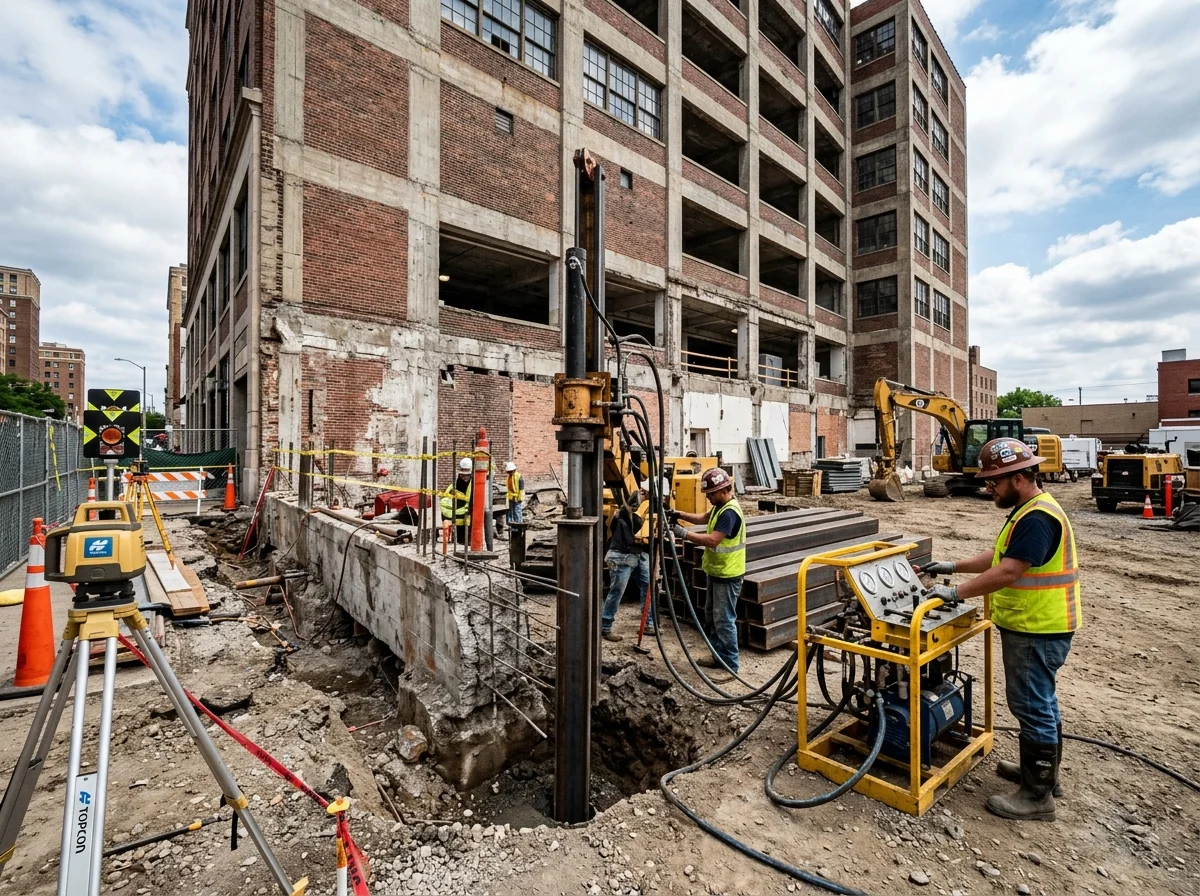
Rather than jacking individual points sequentially, commercial structural lifts require synchronized hydraulic manifold systems. By balancing pressure across dozens of cylinders simultaneously, technicians raise the building smoothly without cracking glass curtain walls or structural masonry.
Digital Telemetry & Pressure Logging
Every pier installation is monitored with calibrated digital pressure gauges and hydraulic telemetry. Technicians record drive depth, hydraulic resistance, and calculated load capacity in real time, verifying safety factors before lifting begins.
Permanent Mechanical Collar Lockoff Assemblies
Once design elevation is restored, high-tensile locking cap screws and positive mechanical nuts lock the pier column permanently to the foundation bracket. Hydraulic cylinders are relieved, transferring building weight completely into the permanent steel assembly.
Commercial Deep Underpinning vs. Alternative Methods
Comparing commercial underpinning methods highlights why verified end-bearing steel piles provide the highest load security and lowest operational disruption:
| Performance Metric | Commercial Push Piers (Recommended) | Commercial Helical Piles | Drilled Micropiles | Mass Concrete Pits |
|---|---|---|---|---|
| Load capacity rating | High-tonnage capacity up to 100+ tons per pier; verified by hydraulic telemetry | High compression and tension capacity up to 50 to 80 tons per pile | High load capacity, but requires specialized drilling rigs, water, and grout curing | Limited load capacity; depends entirely on surrounding soil bearing quality |
| Bearing mechanism | Driven directly to end-bearing refusal on competent Middle Tennessee limestone bedrock | End-bearing plates anchored firmly in dense bedrock or hardpan soil strata | Friction bond between high-strength cement grout and rock or dense overburden | Spreads load over slightly wider soil area, but remains in the same weak upper soil |
| Facility downtime impact | Operates from compact exterior or interior pits with zero disruption to daily business | Rapid rotary installation with zero spoil removal and minimal operational downtime | Significant disruption from heavy drill rigs, grout staging, and slurry disposal | Major hand excavation beneath footings; slow curing creates extended project timelines |
| Quality verification | 100 percent load-tested in-situ during installation against verified hydraulic gauges | Torque-to-capacity correlation monitored continuously with digital telemetry | Requires costly post-installation dynamic or static load testing on select sacrificial piles | Unverifiable capacity; impossible to accurately test in-situ without loading the building |
| Vibration & noise profile | Virtually vibration-free static hydraulic push; safe for sensitive IT and medical equipment | Smooth rotary torque installation with low noise and zero percussive impact | Moderate to high vibration and noise from heavy rotary-percussion drilling equipment | Low installation noise, but dangerous soil undermining during manual tunneling |
Our 8-Step Commercial Underpinning Protocol
Every commercial underpinning project is executed with disciplined quality control, verified telemetry logging, and strict adherence to structural engineering plans:
Geotechnical Review & Structural Engineering Plans
Our commercial engineering team reviews building blueprints, structural column load schedules, and geotechnical soil boring logs to determine pier spacing, target depths, and required safety factors.
Utility Locating & Footing Access Excavation
Ground-penetrating radar (GPR) verifies the location of post-tension cables and sub-slab conduits. Small excavation pockets are opened along exterior grade beams or interior column pads.
Footing Preparation & Heavy-Duty Bracket Mounting
Concrete footings are notched and cleaned to create a flat, true bearing shelf. Heavy-gauge commercial structural steel brackets are mounted flush and secured with high-tensile anchors.
Hydraulic Pier Driving to Bedrock Refusal
High-pressure hydraulic drive cylinders push thick-wall steel casing sections into the ground, adding interlocked sections until reaching engineered refusal on solid limestone bedrock.
In-Situ Proof Load Testing
Each installed pier is individually proof-tested to an engineered factor of safety (typically 1.5 to 2.0 times design working load), confirming that the bedrock interface easily carries structural loads.
Synchronized Multi-Manifold Structural Lifting
Multiple hydraulic cylinders are connected to a central control manifold. Pressure is applied uniformly to raise settled grade beams and column footings back to design elevations.
Permanent Mechanical Collar Lockoff
High-strength mechanical locking hardware is torqued securely into place, transferring structural loads permanently to the steel pier columns and allowing hydraulic equipment removal.
Backfill Compaction & Engineering Sign-Off
Excavation pockets are backfilled with engineered fill and compacted in lifts. We compile hydraulic drive logs, certified depth records, and final PE-stamped documentation for facility records.
Signs Your Commercial Facility Requires Underpinning
Differential settlement causes severe structural and aesthetic distress in commercial properties. Watch for these key indicators:
Stair-Step Cracks in Exterior CMU & Brick Veneer
Diagonal stair-step cracks running through mortar joints in exterior commercial masonry indicate differential settlement along perimeter grade beams and foundation footings.
Expansion Joint Separation on Tilt-Up Concrete Panels
Gaps, sealant tearing, or vertical displacement between precast tilt-up concrete wall panels signal that individual panel footing pads have subsided into soft subgrade soil.
Sticking Commercial Storefront & Overhead Doors
When grade beams drop, commercial storefront aluminum doors, glass curtain wall assemblies, and loading dock rolling overhead doors rack out of square and bind in their tracks.
Diagonal Shear Cracks Around Window Openings
Stress fractures radiating from the corners of commercial window frames or loading bay lintels indicate significant torsional twisting in structural perimeter walls.
Gaps Beneath Structural Steel Column Baseplates
When interior spread footings subside, visible gaps form beneath steel column baseplates, causing ceiling truss deflection, roof ponding, and interior partition distortion.
Differential Settlement at Loading Dock Aprons
Transitions between exterior concrete paving and interior warehouse grade beams develop height offsets, creating severe jolts for forklifts and damaging freight equipment.
Related Commercial & Structural Solutions
Deep foundation underpinning works seamlessly alongside our specialized commercial slab and water management services:
Warehouse Slab Stabilization
High-density geotechnical expanding foam injection to fill voids and stabilize rocking warehouse joints with zero facility downtime.
Concrete Leveling
Precision geotechnical polyfoam lifting for commercial parking aprons, sidewalks, and loading docks to eliminate tripping hazards.
Basement Wall Repair
Commercial carbon-fiber grid straps and heavy earth anchors to stabilize earth-retaining masonry walls deflected by lateral soil pressure.
Foundation Crack Repair
Structural high-pressure epoxy injection to weld fractured commercial grade beams and waterproof subgrade masonry cracks.
Commercial Underpinning Across Middle Tennessee
We provide commercial underpinning, steel pile driving, and foundation stabilization across all 12 counties in the Greater Nashville region:
Commercial Underpinning Questions Answered
Clear engineering answers regarding pier load capacities, facility uptime, bedrock refusal, and PE documentation for Middle Tennessee commercial facilities:
How much load can a commercial steel push pier support?
Commercial steel push piers are engineered for high-tonnage structural applications, typically supporting working loads between 30 and 100+ tons per pier depending on tube diameter, steel wall thickness, and bedrock competence. Because Middle Tennessee geology features massive, competent limestone bedrock, piers can be driven to exceptional refusal pressures, allowing each pier to carry massive commercial loads with generous safety factors.
Can commercial underpinning be performed without shutting down our business?
Yes. In the vast majority of commercial projects, underpinning is executed entirely from exterior perimeter access pockets or small interior floor openings without disrupting operations. Our low-vibration hydraulic push systems produce virtually zero noise or percussive impact, allowing retail centers, medical clinics, offices, and distribution hubs to remain open and fully operational throughout the installation.
What is the difference between commercial push piers and commercial helical piles?
Commercial push piers use the existing dead weight of the building as a hydraulic reaction force to drive heavy-wall steel casing sections down to bedrock refusal. They are ideal for heavy existing structures. Commercial helical piles feature circular steel helix plates welded to a high-torque shaft and are mechanically rotated into the soil. Helical piles are ideal for lighter commercial buildings, tension applications (resisting wind uplift or seismic loads), and pre-construction deep foundation support.
How deep do commercial piers need to go in Middle Tennessee?
Pier depths in Middle Tennessee vary based on local topography and overburden depth. In areas like downtown Nashville, Franklin, and Brentwood, competent limestone bedrock is often reached between 15 and 35 feet below grade. In alluvial river bottoms near the Cumberland or Stones River, or in deep cut-and-fill logistics parks in Lebanon and Murfreesboro, depths can reach 40 to 60 feet before achieving verified refusal.
How does synchronized manifold lifting protect commercial glass and curtain walls?
Lifting commercial grade beams one point at a time creates severe localized shear stress that can easily shatter structural glass, crack precast concrete panels, or twist steel structural frames. Our multi-port hydraulic manifolds distribute hydraulic pressure evenly across all installed cylinders at once. By lifting the foundation uniformly in small 1/16-inch increments, building elevation is restored smoothly without introducing destructive torsional forces.
Do your commercial underpinning projects include engineering certifications?
Yes. Every commercial underpinning project is executed in close coordination with structural engineering design specifications. We document hydraulic drive pressures, final bearing depths, and proof-load testing for every individual pier. Upon completion, we provide comprehensive engineering documentation, including hydraulic logs and certified inspection reports for commercial facility records and municipal compliance.
Schedule a Commercial Underpinning Engineering Consultation
Safeguard your commercial building against structural settlement and operational disruption. Our commercial foundation specialists provide comprehensive on-site evaluations, laser elevation surveys, and engineered underpinning plans across Nashville and Middle Tennessee.
Serving Nashville, Franklin, Brentwood, Murfreesboro, Hendersonville, Mount Juliet, Lebanon, and all surrounding Middle Tennessee commercial centers.