Warehouse Slab Stabilization in Nashville & Middle Tennessee
Eliminate rocking floor joints, level sunken forklift aisles, and fill subgrade voids without halting logistics operations. Our high-density geotechnical polyurethane foam injection stabilizes commercial concrete slabs through non-destructive 5/8-inch ports, curing to full load capacity in just 15 minutes for immediate equipment traffic.
Up to 14,000 PSF
Compressive Strength
High-density closed-cell polymer engineered for heavy industrial axle loads
5/8 Inch
Port Diameter
Dime-sized injection holes preserve commercial concrete floor appearance
15 Minutes
Full Traffic Return
Rapid polymer cure avoids costly logistics and distribution facility shutdowns
3 to 5 Lbs/Cu.Ft.
Weight on Subgrade
Ultralight geotechnical foam will not overburden weak underlying fill soils
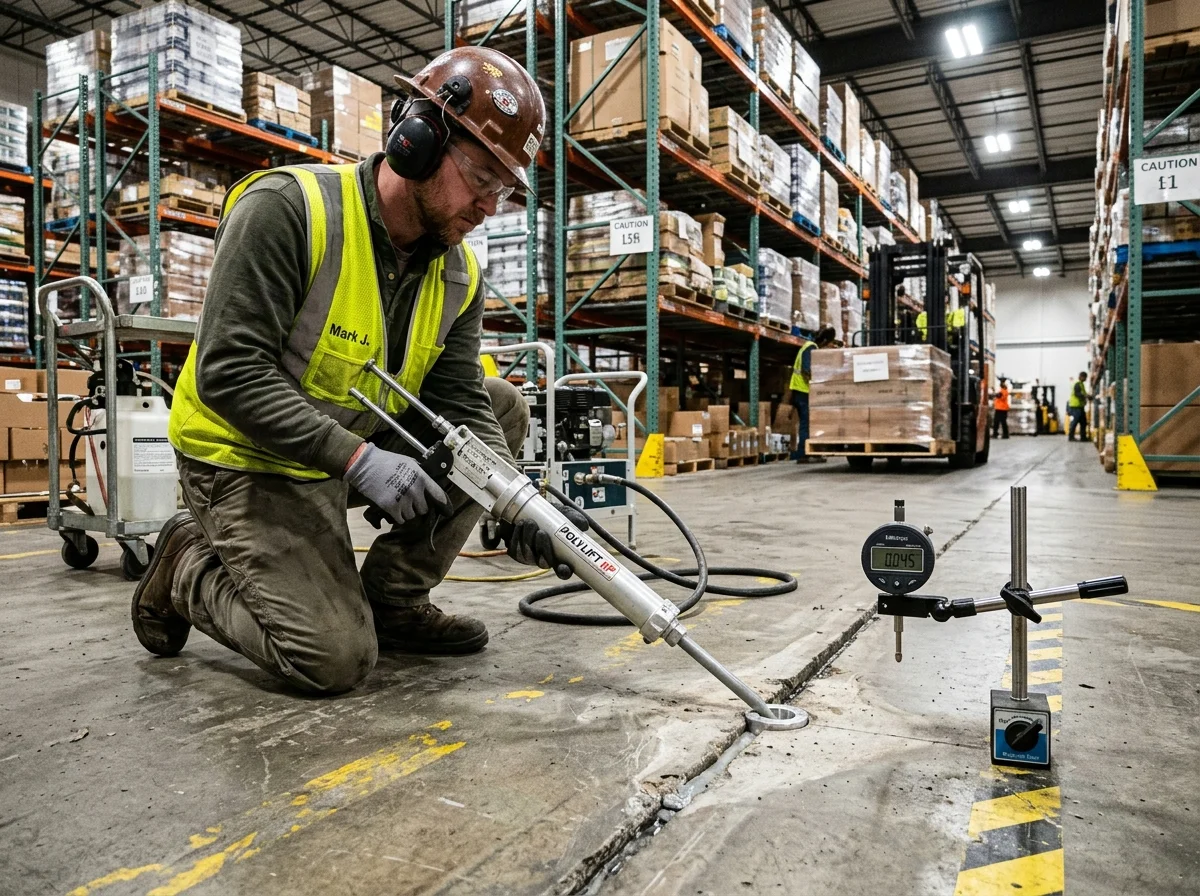
Why Warehouse Floors Deflect & Joints Rock Under Traffic
Understanding the mechanical dynamics of industrial concrete reveals why traditional surface patches fail and deep geotechnical stabilization is required:
High-Frequency Dynamic Axle Loads & Slab Pumping
Loaded forklifts and reach trucks carry extreme concentrated axle weights on small, hard solid polyurethane wheels. As these wheels roll across saw-cut contraction joints, the dynamic weight pushes the slab edge downward.
This continuous flexing creates a mechanical pumping action that pulverizes sub-base aggregate, ejecting fine silt through the joint as dust or slurry. Over time, air voids form directly beneath the joint, leaving concrete edges completely cantilevered and unsupported.
Subgrade Consolidation in Deep Cut-and-Fill Soils
Large logistics centers across Antioch, Murfreesboro, Lebanon, and Mount Juliet were built over massive cut-and-fill pads. Inadequately compacted soil slowly consolidates beneath continuous high-bay pallet racking loads.
As the sub-base sinks away from the underside of the slab, large hollow voids develop. Without uniform support, concrete panels crack under forklift impact, leading to severe joint spalling, damaged freight, and operator safety hazards.
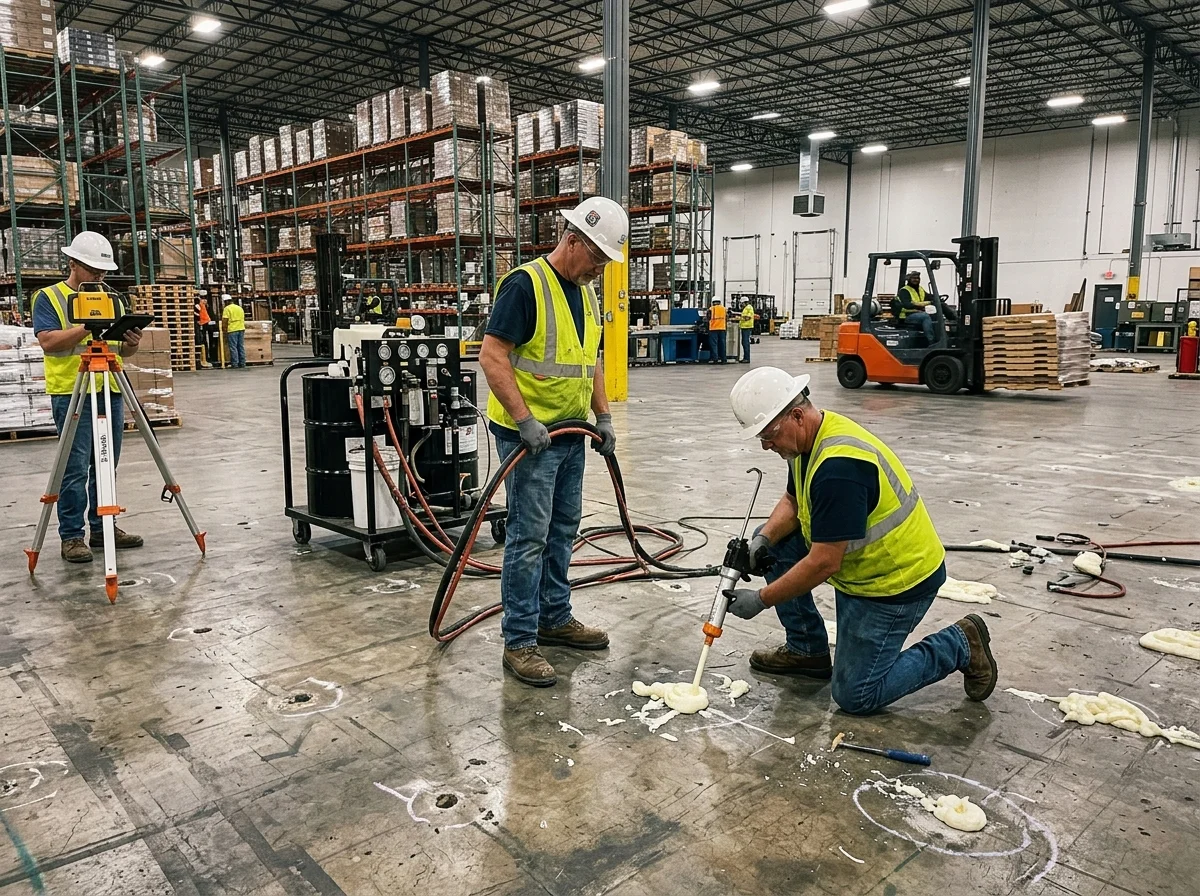
Components of an Engineered Warehouse Slab Stabilization System
Our geotechnical void filling systems use specialized industrial-grade components designed to deliver permanent load bearing and joint stability:
Non-Destructive 5/8-Inch Delivery Ports
Rather than cutting large core holes or saw-cutting floor panels, technicians drill small 5/8-inch ports along settled joint lines. These tiny access points allow high-pressure injection while preserving floor joint integrity and surface aesthetics.
High-Density Geotechnical Polyurethane
Our two-part commercial polymers are formulated specifically for high-load industrial environments. Expanding rapidly upon injection, the hydrophobic material displaces standing sub-slab water, fills washouts, and densifies loose subgrade stone with immense expanding force.
Mobile Proportioner Delivery Units
Computerized proportioning equipment maintains precise temperature and pressure ratios. Heated hoses deliver expanding polymer directly to the injection gun, guaranteeing uniform chemical reaction, predictable expansion, and certified compressive strength.
Dial Indicator & Laser Telemetry Monitoring
Precision magnetic-base dial indicators placed across expansion joints monitor slab elevation recovery in thousandths of an inch. Technicians adjust injection rates in real time, preventing over-lifting and restoring smooth forklift transitions.
Semi-Rigid Industrial Polyurea Joint Sealants
Following slab stabilization, spalled joint shoulders are rebuilt and sealed with heavy-duty semi-rigid polyurea joint filler. The elastomeric filler supports solid forklift tires as they roll over joints, preventing future edge crumbling.
Color-Matched Cementitious Port Micro-Patching
Once injection is complete, mechanical delivery ports are cleared and patched flush with high-strength, color-matched epoxy mortar. The patched holes blend smoothly with surrounding polished or sealed concrete.
Geotechnical Foam vs. Traditional Industrial Floor Repairs
Comparing commercial repair methods illustrates why geotechnical polyurethane injection is the preferred engineering solution for active distribution facilities:
| Feature | Geotechnical Foam (Recommended) | Mudjacking Slurry | Pressure Grouting | Slab Demolition & Repour |
|---|---|---|---|---|
| Operational facility downtime | Complete cure in 15 to 30 minutes; immediate resumption of heavy forklift traffic | 24 to 48 hours of curing; requires shutting down logistics bays and traffic lanes | Extended cure; heavy cementitious slurry disrupts operations and creates wet jobsite mess | Weeks of downtime for saw-cutting, concrete removal, re-pouring, and 28-day cure |
| Added weight on subgrade | Ultralight polymer adds only 3 to 5 lbs/cu.ft., eliminating sub-base overloading | Heavy topsoil and cement slurry adds 100 to 120 lbs/cu.ft., accelerating soil failure | Dense cement grout adds 120 to 140 lbs/cu.ft., stressing weak underlying fill | Replaces heavy slab with another heavy slab over the same uncompacted subgrade |
| Injection port diameter | Small 5/8-inch drill ports; virtually unnoticeable after color-matched patching | Large 1.5 to 2-inch core holes leave conspicuous circular scars across the floor | Large 2 to 3-inch core holes leave unsightly patchwork across warehouse aisles | Destroys existing floor finishes, post-tension cables, and embedded joint armor |
| Moisture & washout resistance | 100 percent hydrophobic closed-cell polymer; will not wash out, degrade, or erode | Water-based organic mix washes out easily under persistent sub-slab plumbing leaks | Rigid grout can crack or wash away if underlying water flow persists during cure | New concrete remains vulnerable to the same subgrade erosion and washouts |
| Compressive strength under forklifts | Engineered compressive strength up to 14,000+ PSF easily supports heavy dynamic axle loads | Variable compressive strength; slurry crushes and powders under high-frequency wheel loads | High compressive strength, but brittle nature can fracture under dynamic slab deflection | High compressive strength, but requires weeks of catastrophic production stoppage |
Our 8-Step Warehouse Slab Stabilization Protocol
Every warehouse stabilization project is executed with disciplined precision, dial indicator telemetry, and minimal facility disruption:
GPR Sub-Slab Void Mapping & Joint Telemetry
Our industrial specialists conduct an on-site structural evaluation, using ground-penetrating radar (GPR) to locate hidden subgrade air pockets and mapping joint rocking with digital dial indicators.
Dial Indicator Baseline Setup
High-precision digital dial indicator gauges on magnetic stands are positioned across moving joint lines to track slab movement in thousandths of an inch during the injection process.
Precision 5/8-Inch Injection Port Drilling
Technicians drill small 5/8-inch holes in a calculated grid pattern along joint shoulders and across sunken slab sections, using HEPA-filtered vacuum attachments to capture concrete dust.
Subgrade Deep Foam Injection & Void Filling
Specialized delivery guns inject two-part high-density geotechnical polymer beneath the slab. The expanding material flows into microscopic soil voids and washouts, displacing trapped moisture.
Controlled Elevation Recovery & Joint Alignment
As voids fill, continuing polymer expansion exerts controlled upward pressure. Technicians monitor dial gauges to raise deflected slab edges back into perfect alignment with adjacent bays.
Port Cleaning & Color-Matched Mortar Patching
Injection tubes are removed, and the 5/8-inch ports are cleaned and filled flush with high-strength cementitious mortar tinted to match existing warehouse concrete.
Polyurea Joint Edge Rebuilding & Sealing
Spalled joint shoulders are mechanically prepped and sealed with heavy-duty semi-rigid polyurea joint filler to protect concrete edges against solid forklift wheel impact.
Forklift Proof Traffic Audit & Sign-Off
Within 15 minutes of completion, heavy forklifts are driven across repaired joints to verify zero deflection. Technicians provide certified lift logs and completion documentation.
Signs Your Warehouse Slabs Require Immediate Stabilization
Sub-slab voids and rocking joint deflection create severe operational hazards. Watch for these symptoms:
Rocking or Deflecting Joints Under Forklift Traffic
When a forklift rolls across a joint line and the slab visibly tilts or pumps downward, sub-base soil has consolidated and formed voids beneath the joint edge.
Spalled, Broken, or Chipped Joint Shoulders
Repeated wheel impacts on unsupported joint edges cause concrete to fracture and crumble, creating deep ruts that damage forklift tires and jolt drivers.
Uneven Height Offsets Between Warehouse Bays
Noticeable elevation differences between adjacent slab panels create dangerous tripping hazards for workers and cause material handling equipment to drag.
Leaning or Misaligned High-Bay Pallet Racks
When concrete slabs settle beneath heavy rack uprights, tall pallet racking tilts out of plumb, creating severe structural safety hazards and violating OSHA tolerances.
Forklift Driver Fatigue & Equipment Maintenance Spikes
Operators complaining of back strain from rough floor transitions, along with accelerated replacement of solid polyurethane tires and wheel bearings, signal slab failure.
Hollow Thumping Sounds Over Concrete Slabs
Driving equipment or tapping over concrete that produces a hollow acoustic response confirms that sub-slab soil has subsided, leaving an unsupported concrete bridge.
Related Commercial & Structural Solutions
Warehouse slab stabilization works seamlessly alongside our deep structural underpinning and concrete leveling services:
Commercial Underpinning
High-capacity steel push piers and helical piles driven to bedrock to permanently stabilize settled commercial grade beams and column pads.
Concrete Leveling
Polyfoam lifting for commercial exterior sidewalks, loading dock aprons, and dumpster pads to eliminate trip hazards.
Basement Wall Repair
Commercial carbon-fiber grid straps and heavy earth anchors to stabilize earth-retaining masonry walls deflected by lateral soil pressure.
Foundation Crack Repair
Structural high-pressure epoxy injection to weld fractured commercial grade beams and waterproof subgrade masonry cracks.
Warehouse Slab Stabilization Across Middle Tennessee
We provide warehouse joint repair, slab leveling, and industrial void filling across all primary logistics corridors in Greater Nashville:
Warehouse Slab Stabilization Questions Answered
Clear engineering answers regarding forklift uptime, compressive strength, joint rocking mechanics, and industrial void filling in Middle Tennessee:
How quickly can forklifts drive on the floor after warehouse slab stabilization?
Forklifts, reach trucks, and heavy material handling equipment can resume full operational traffic within 15 to 30 minutes following injection. Our commercial geotechnical polyurethane foams achieve 90 percent of their full compressive strength in approximately 15 minutes, allowing distribution facilities to complete repairs without halting logistics operations or scheduling weekend shutdowns.
Why do warehouse floor slabs rock and pump at expansion joints?
Warehouse floor joints rock due to void formation in the underlying sub-base. Industrial forklifts carry immense wheel loads on small, hard solid tires. As trucks pass over joint seams, dynamic weight forces the slab edge downward. This pumping action displaces underlying gravel and pumps fine subgrade silt out through the joint. Over time, air pockets form beneath the concrete, leaving the joint edges completely unsupported.
How does geotechnical foam compare to traditional mudjacking for warehouse floors?
Traditional mudjacking pumps a heavy mixture of water, topsoil, and cement through large 2-inch holes. This heavy slurry adds 100 to 120 pounds per cubic foot to already weak subgrade soil, often triggering secondary settlement. Furthermore, mudjacking takes 24 to 48 hours to cure and washes out under moisture. Our geotechnical foam adds only 3 to 5 pounds per cubic foot, requires tiny 5/8-inch holes, cures in 15 minutes, and will never wash out or degrade.
Can high-density foam injection support high-bay pallet racking loads?
Yes. Our commercial-grade geotechnical foams are engineered with compressive strengths ranging from 6,000 to 14,000+ pounds per square foot (or higher for custom formulations). By filling subgrade voids and consolidating loose sub-base material into a dense composite, the polymer restores uniform bearing capacity, easily supporting multi-tier pallet racking and high point loads.
Will the small 5/8-inch injection holes damage our finished warehouse floor?
No. The 5/8-inch drill ports are approximately the size of a dime. Once injection is complete, technicians remove the injection ports, clean the holes, and patch them flush with industrial-grade, color-matched epoxy mortar. The patched holes blend seamlessly into polished, sealed, or painted warehouse concrete with minimal visual impact.
What areas of Middle Tennessee do you service for warehouse slab repairs?
We service commercial warehouses, distribution hubs, manufacturing plants, and logistics facilities across the entire Greater Nashville region, including major industrial corridors in Antioch, Murfreesboro, Lebanon, Mount Juliet, La Vergne, Smyrna, Franklin, and Clarksville.
Schedule an Industrial Floor Stabilization Consultation
Stop rocking joints, forklift damage, and warehouse tripping hazards without shutting down your facility. Our commercial specialists provide on-site void mapping, joint deflection audits, and customized polymer stabilization plans across Nashville and Middle Tennessee.
Serving Nashville, Antioch, Murfreesboro, Lebanon, Mount Juliet, La Vergne, Smyrna, Franklin, and all surrounding Middle Tennessee logistics centers.