Concrete Leveling in Nashville & Middle Tennessee
Sunken driveways, uneven walkways, and sloping patio slabs create serious trip hazards and poor water drainage around your home. Our high-density polyurethane foam lifting process raises settled concrete slabs back to flush elevation within 30 minutes, using penny-sized injection holes and causing zero yard damage.
Lift Precision
1/8-Inch Control
Port Size
5/8-Inch Micro-Ports
Weight Load
2 to 4 lbs / cu. ft.
Traffic Ready
15 to 30 Minutes
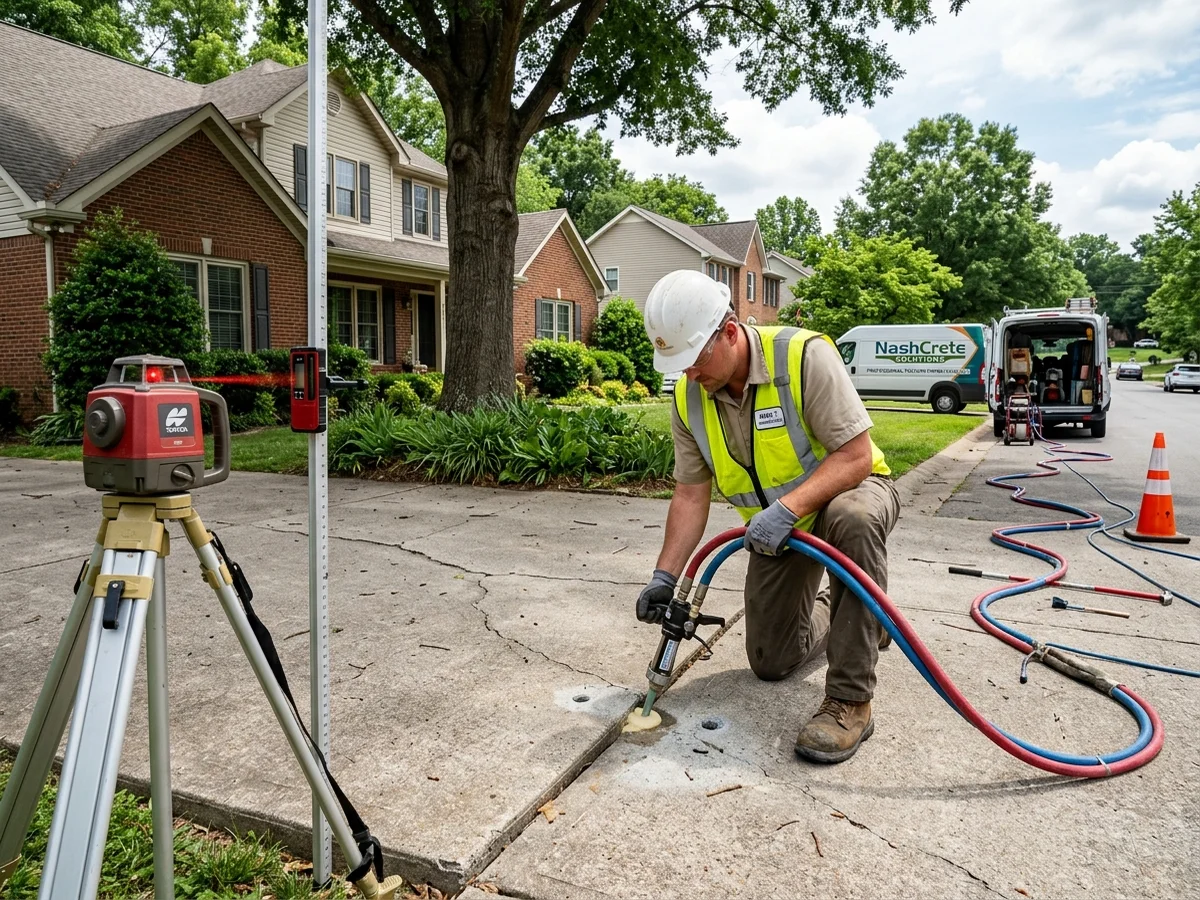
Non-invasive polyurethane foam injection on a residential driveway. Micro-ports preserve surface appearance while closed-cell polymers lift the slab flush with millimeter laser accuracy.
Signs Your Concrete Flatwork Has Settled
Concrete slabs do not settle uniformly. Uneven subsoil compaction, water erosion, and seasonal clay shrinkage cause individual panels to drop, creating distinct warning signs across your property:
Sinking Driveway Slabs & Bumper Scraping
When driveway panels settle at the garage threshold or road apron, vehicles scrape their underside entering or exiting. Uneven panels also channel stormwater toward the garage instead of the street.
Sidewalk & Walkway Trip Hazards
Differences exceeding one-quarter inch between walkway panels create dangerous tripping hazards for family, guests, and delivery carriers. These sudden height steps often violate local municipal safety codes.
Sloping Patios & Water Pooling
Settled patio slabs slope back toward the home exterior walls, allowing rainwater to pond against brick veneer, crawl space vents, and basement stem walls during Middle Tennessee downpours.
Sunken Garage Floors & Door Gaps
When a garage slab drops along its front edge, overhead door bottom seals no longer make contact with the floor. Cold drafts, driving rain, leaves, and pests enter freely beneath the garage door.
Separated Front Steps & Porch Stoops
Heavy masonry steps and poured concrete entry stoops pull away from the main exterior facade, creating unsightly gaps, cracked caulking, and unstable footing at the primary front entry.
Dislocated Pool Decks & Coping Damage
Concrete pool surrounds that subside stress underground plumbing lines, misalign perimeter coping stones, and leave uneven walking surfaces around swimming areas.
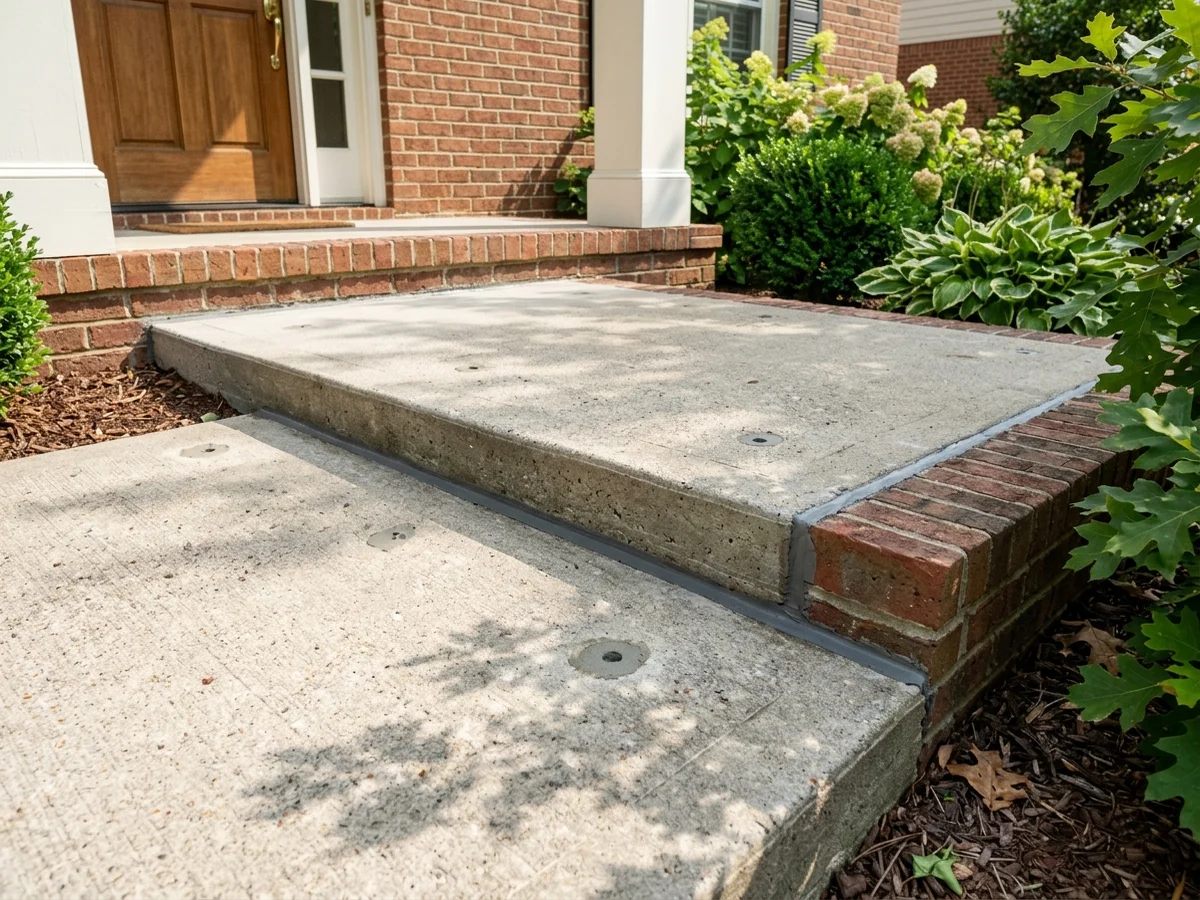
Restored front entryway walkway. Slabs lifted flush with porch threshold masonry, eliminating safety hazards without tearing out existing concrete.
Why Concrete Sinks in Middle Tennessee
Concrete itself does not fail simply due to age. It settles because the ground beneath it loses the density and volume required to support heavy slabs. In Greater Nashville, distinct geotechnical factors accelerate flatwork sinking:
Uncompacted Subdivision Fill Soil
In fast-developing communities across Murfreesboro, Lebanon, Spring Hill, and Williamson County, modern home sites rely on heavy earthmoving and cut-and-fill grading. Subsoil placed without proper compaction consolidates over time, leaving hollow subterranean voids beneath unreinforced flatwork.
Expansive Clay Swell-Shrink Dynamics
Middle Tennessee soil contains dense concentrations of expansive smectite clay. During humid, rainy winters, the clay swells; during severe summer dry spells, it contracts drastically. Concrete slabs crack and settle when the clay shrinks away from the underside of the slab.
Roof Downspout & Drainage Washout
Gutters and downspouts discharging water directly next to driveways, walkways, and patios saturate base gravel. Rushing water erodes supportive bedding material, creating empty voids where concrete panels quickly collapse under their own weight.
Buried Construction Debris & Organic Decay
Tree stumps, roots, and organic matter buried during initial subdivision construction rot away over five to fifteen years. As this organic volume decays into loose humus, the overlying driveway and patio slabs drop unevenly.
Polyurethane Foam Lifting vs. Mudjacking & Replacement
Property owners historically faced two flawed choices for sunken concrete: invasive total slab replacement or heavy cementitious mudjacking. High-density structural foam provides an engineered solution that addresses the underlying soil weakness without the drawbacks of older methods:
| Comparison Feature | Polyurethane Foam (Polyjacking) | Traditional Mudjacking | Total Slab Replacement |
|---|---|---|---|
| Injection Hole Diameter | 5/8-inch (size of a penny) | 1.5 to 2 inches (size of a soda can) | Full structural tear-out with jackhammers |
| Material Weight Added to Subgrade | 2 to 4 lbs per cubic foot (ultra-light) | 100 to 120 lbs per cubic foot (very heavy) | 145 lbs per cubic foot (heavy fresh concrete) |
| Cure Time & Usability | Ready for vehicle traffic in 15 to 30 minutes | Requires 24 to 72 hours before driving on it | Requires 7 to 28 days of concrete cure time |
| Moisture & Washout Resistance | 100 percent hydrophobic; will not wash away | Vulnerable to water erosion and slurry washout | Prone to the same base washout that sank original slab |
| Impact on Yard & Landscaping | Hoses run from self-contained truck; zero lawn damage | Heavy pump trucks and wheelbarrows rut grass | Bobcats, dumpsters, and concrete trucks destroy turf |
Why Weight Matters in Middle Tennessee: When traditional mudjacking injects hundreds of pounds of wet slurry beneath a settled driveway, it places immense downward pressure on the same expansive clay that failed initially. In contrast, closed-cell structural foam adds virtually zero weight while consolidating weak subgrade particles and providing permanent, waterproof support.
Our 5-Step Precision Concrete Leveling Process
Every concrete leveling project follows a rigorous, non-destructive sequence engineered to stabilize the underlying soil and restore precise elevation with minimal disruption to your daily schedule:
Precision Laser Elevation Survey
Our technicians map slab elevations using digital altimeters and laser receivers. We identify exact settlement depths, drainage slopes, and hidden sub-slab voids across your driveway, patio, or walkway.
Micro-Port Drilling
We drill small, discrete 5/8-inch holes in strategic patterns through the settled concrete. These holes are roughly the diameter of a penny, preserving slab integrity and minimizing cosmetic disruption.
High-Density Polyurethane Injection
Specialized proportioner equipment delivers a two-part liquid geopolymer beneath the slab. Within seconds, the liquid expands into a rigid, closed-cell structural foam that fills every underlying subterranean void.
Controlled Slab Lift & Alignment
As the expanding foam densifies the subgrade, it generates controlled hydraulic lifting pressure. Technicians monitor laser receivers to lift the slab within an eighth of an inch of adjacent concrete surfaces.
Clean Port Patching & Joint Sealing
We remove injection ports and seal drill holes with custom color-matched cementitious grout. Control joints are sealed with commercial-grade polyurethane caulk to prevent future water infiltration.
Dedicated Concrete Leveling Services
Explore our specialized flatwork restoration services tailored to specific areas of your Middle Tennessee residential property:
Driveway Concrete Leveling
Lift sunken driveway panels flush with your garage floor and road apron. Eliminate bumper scraping and restore positive drainage away from your home foundation.
Patio & Walkway Leveling
Remove dangerous trip hazards from front entry sidewalks, garden paths, and backyard patios. Realign sunken concrete steps to restore safe, code-compliant access.
Garage Floor Leveling
Correct settled garage slabs that allow water, cold drafts, and pests to bypass overhead door bottom seals. Stabilize interior vehicle parking bays without concrete demolition.
Related Foundation & Soil Solutions
Settling concrete flatwork often coincides with broader structural movement around your foundation perimeter. We provide full-spectrum repair services:
Slab Foundation Repair
Structural lifting and void filling for residential monolithic slab-on-grade homes experiencing interior floor settling or drywall cracks.
Foundation Crack Repair
Structural epoxy pressure injection and polyurethane crack sealing to restore structural integrity and prevent water seepage through stem walls.
Foundation Waterproofing
Sub-slab French drains and dual-pump sump systems to relieve the hydrostatic groundwater pressure that causes basement seepage and flatwork erosion.
Concrete Leveling Across Middle Tennessee
We provide mobile polyurethane concrete lifting and flatwork leveling across all 12 communities in Greater Nashville and the Highland Rim:
Looking for concrete leveling in Murfreesboro or Rutherford County?
Explore our specialized guide for driveway, sidewalk, and patio leveling over subdivision fill.
Concrete Leveling Questions Answered
Clear technical answers regarding polyfoam lifting, drive times, soil conditions, and trip hazard remediation:
How does polyurethane foam concrete leveling work?
Polyurethane concrete leveling, often called polyjacking, works by injecting a two-part liquid polymer through small 5/8-inch holes drilled into the sunken concrete. Beneath the slab, the liquids react and expand into a high-density, closed-cell foam. As it expands, it fills empty soil voids, compacts loose subgrade soil, and gently lifts the concrete back to its original level position.
How long before I can drive or walk on the leveled concrete?
Polyurethane foam cures through a rapid chemical reaction rather than evaporation. It reaches 90 percent of its full compressive strength within 15 minutes of injection. Walkways and patios can be walked on immediately, and driveways can accommodate heavy passenger vehicles, SUVs, and trucks within 30 minutes of repair completion.
Why is polyfoam lifting better than traditional mudjacking?
Traditional mudjacking pumps a heavy mixture of water, topsoil, and Portland cement through large 2-inch holes. Mudjacking slurry weighs over 100 pounds per cubic foot, which adds immense overburden weight to already weak Middle Tennessee clay, frequently causing the slab to sink again. High-density polyurethane weighs only 2 to 4 pounds per cubic foot, requires penny-sized holes, and is completely waterproof, meaning it will never wash away or erode in heavy rains.
Will the drill holes be noticeable after the repair?
Our technicians drill micro-ports that are only 5/8-inch in diameter, which is about the size of a penny. Once lifting is complete, each hole is filled with a specialized cementitious patch tinted to match the tone and texture of your existing concrete. Within a short time, weathering causes the patched ports to blend cleanly into the surrounding surface.
Can severely cracked or shattered concrete be leveled?
If a concrete slab is broken into large intact sections with differential settlement, polyurethane foam can lift each individual section back into alignment. However, if concrete is shattered into small gravel-like pieces or has suffered severe surface spalling from rebar corrosion, lifting will not restore structural integrity. During our free on-site inspection, our specialists will honestly evaluate whether leveling or section replacement is your best approach.
What happens if there is water under my sunken concrete slab?
The polyurethane polymers we utilize are completely hydrophobic, meaning they repel water rather than absorbing it. During injection, the expanding foam actively displaces standing groundwater under the slab and cures into an impervious, solid structural barrier. It will not break down, wash away, or leach chemicals into the surrounding soil.
How does leveling a concrete patio or walkway protect my home foundation?
When patios and walkways sink, they frequently slope toward your home exterior walls instead of draining into the yard. Rainwater runs directly against brick veneer, crawl space vents, and basement walls, saturating the foundation perimeter clay and leading to basement wall bowing or crawl space moisture. Leveling restores proper outward slope, shedding stormwater safely away from your foundation.
Schedule Your Free Concrete Leveling Inspection
Do not let sunken driveways or dangerous walkway trip hazards worsen. Our team provides thorough on-site laser evaluations, void mapping, and transparent engineering guidance across Nashville and Middle Tennessee.
Serving Nashville, Franklin, Brentwood, Murfreesboro, Hendersonville, Mount Juliet, Lebanon, Columbia, and all surrounding Middle Tennessee communities.