Why Foundations Settle in Middle Tennessee: Expansive Clay and Weather Cycles
Middle Tennessee is renowned for its picturesque rolling hills and limestone topography, but beneath the surface lies one of the most challenging geotechnical environments for residential construction in the United States.
Nashville Foundation Experts Engineering Team
Structural Foundation & Geotechnical Specialists
Direct Answer / Key Engineering Takeaway
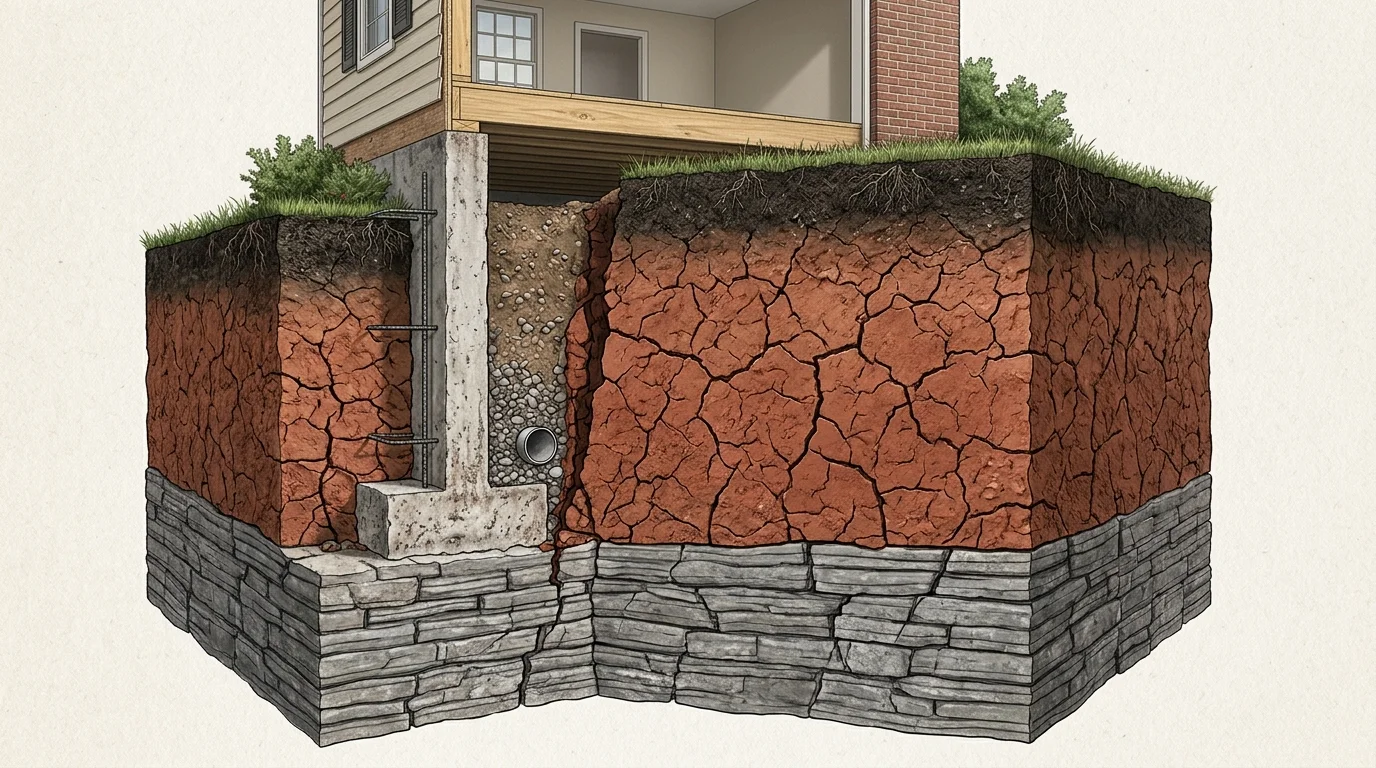
Foundation settlement in Middle Tennessee is primarily driven by highly reactive smectite clay soils interacting with seasonal weather extremes over shallow limestone bedrock. During hot, dry summer months, clay topsoil desiccates and shrinks, pulling support out from underneath concrete footings. In heavy winter and spring rainfall, the clay swells aggressively with intense upward hydrostatic pressure. This repeated shrink-swell cycle leads to differential settlement, foundation corner drops, and structural distortion.
The Geological Profile of the Nashville Central Basin
An ancient Ordovician limestone seabed covered by a thin clay mantle.
To understand why foundations move in Nashville, Franklin, Murfreesboro, and Lebanon, one must look at regional geological history. Middle Tennessee lies in a geological dome known as the Nashville Basin (Central Basin). Hundreds of millions of years ago, shallow prehistoric seas deposited thick layers of calcium carbonate, which compressed into dense Ordovician limestone.
Over millions of years, weathering broke down the upper layers into residual clay soils. In many areas, this soil mantle is remarkably thin, often only two to four feet deep before meeting solid limestone rock. In other areas, such as old river terraces and valleys, clay deposits can reach depths of 15 to 30 feet.
This uneven bedrock depth creates the primary condition for foundation distress: when a single residential footing rests partially on shallow limestone and partially on deep, compressible clay, differential settlement becomes almost inevitable.
The Smectite Clay Shrink-Swell Cycle Explained
How microscopic clay mineral structures expand and contract like sponges.
The predominant clay mineral across Middle Tennessee is smectite (often including montmorillonite). Smectite clays possess an expansive crystal lattice that absorbs large quantities of water molecules into its interlayer spaces.
During wet spring months, when Middle Tennessee receives an average of four to five inches of rain per month, the clay absorbs moisture and expands dramatically. Geotechnical engineers refer to this as soil swelling. The expanding clay exerts tremendous upward pressure, known as swell pressure, which can exceed 3,000 to 5,000 pounds per square foot, capable of lifting concrete driveways and floor slabs.
Conversely, during prolonged summer dry spells in July, August, and September, the high heat desiccates the upper soil layers. As moisture evaporates, the clay particles contract tightly together. The soil shrinks, develops wide fissures, and physically pulls away from foundation footings. Without soil support beneath the exterior perimeter, the concrete footing drops under the heavy weight of the home.
Differential Settlement: The Real Cause of Structural Damage
Why uniform downward movement rarely harms a house, but uneven movement does.
If an entire house settled uniformly by one inch across all four corners, the homeowners would likely never notice. Doors would still open smoothly, windows would operate without sticking, and drywall would remain uncracked.
Structural damage occurs when one corner or wall of a home settles while the remainder of the foundation stays firmly in place. This uneven movement is called differential settlement.
Differential settlement twists the rigid structural box of the house. As wood framing, masonry veneers, and roof trusses distort under torsional stress, cracks form at weak structural junctions: above interior doorways, across foundation corners, and along exterior mortar joints.
County-by-County Geotechnical Variations Across Middle Tennessee
Distinct soil challenges from Montgomery to Rutherford County.
While expansive clay is a common denominator, each county in the greater Nashville metropolitan region presents unique geotechnical challenges:
Geotechnical Profiles Across Middle Tennessee Counties
| County & Hub | Geological Character | Primary Foundation Challenge |
|---|---|---|
| Davidson County (Nashville) | Urban fill, river alluvial silt, and historic brick masonry foundations | Variable fill compaction in redeveloped neighborhoods; masonry footing washouts |
| Williamson County (Franklin) | Heavy, high-plasticity smectite clays on sloping hillside terrain | Severe shrink-swell movement; foundation creep on hillsides; stem wall cracking |
| Rutherford County (Murfreesboro) | Cut-and-fill subdivision grading over deep clay pockets | Interior slab-on-grade settlement; concrete flatwork voiding; garage apron drops |
| Montgomery County (Clarksville) | Karst topography with underground sinkhole fissures and solution cavities | Localized sinkhole settlement; moisture pooling under post-war crawl spaces |
| Wilson County (Lebanon) | Cedar glade topography with shallow limestone ledges under thin clay | Summer drought desiccation pulling support from exterior footings; rock ledge seepage |
Permanent Structural Underpinning: Bypassing Unstable Soils
Why surface remedies fail and deep steel piers succeed.
Homeowners frequently attempt to mitigate soil shrinkage by running soaker hoses around their foundation perimeter during hot summer months. While maintaining uniform soil moisture can help stabilize minor seasonal expansion, it cannot reverse established structural settlement or guarantee uniform subgrade moisture.
The definitive, engineered solution for Middle Tennessee foundation settlement is deep foundation underpinning. Specialized heavy-duty steel push piers or helical torque piers are mechanically driven through the active clay layer until they reach true refusal on competent limestone bedrock.
Once anchored into solid rock, hydraulic lifting manifolds transfer the structural weight of the home off the unstable clay and onto the steel pier columns. This permanently isolates the foundation from weather cycles and seasonal soil movement.
Frequently Asked Questions
Need An On-Site Structural Evaluation?
Speak directly with an experienced Middle Tennessee foundation specialist. We will discuss the symptoms you are observing and perform an on-site laser level elevation survey with zero travel fees.