Are Foundation Cracks Serious? How to Identify Dangerous Wall Cracks
Discovering a crack in your foundation wall or exterior brick veneer naturally triggers anxiety. For homeowners in Middle Tennessee, understanding the difference between cosmetic curing flaws and structural foundation settlement is essential for protecting your property and making sound maintenance decisions.
Nashville Foundation Experts Engineering Team
Structural Foundation & Geotechnical Specialists
Direct Answer / Key Engineering Takeaway
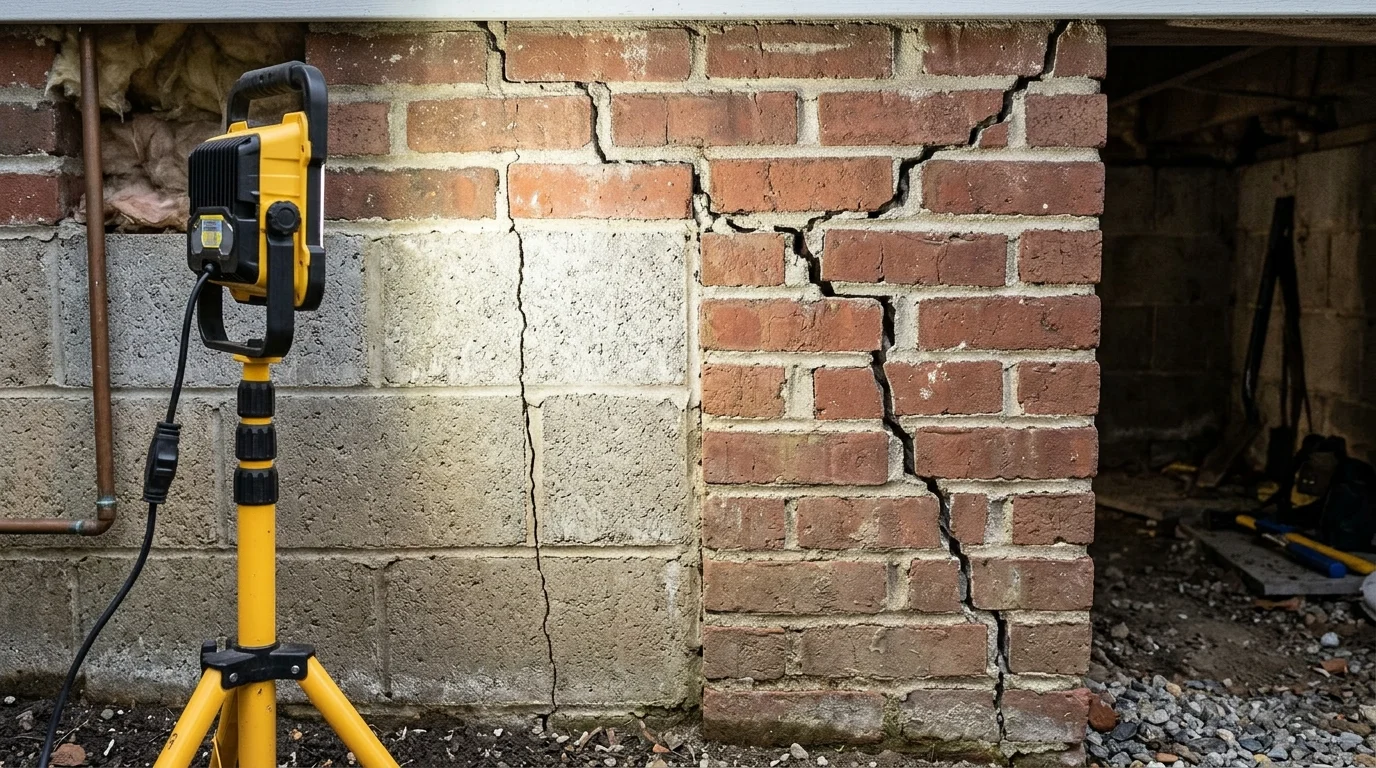
Not every foundation crack indicates structural failure, but certain patterns signal severe distress. Vertical hairline cracks under one-sixteenth of an inch are typically benign concrete shrinkage cracks formed during initial curing. In contrast, horizontal cracks across concrete block walls, stair-step cracks along masonry joints wider than one-quarter of an inch, and cracks accompanied by sticking doors or wall separation indicate active foundation settlement or lateral hydrostatic soil pressure requiring professional stabilization.
The Three Primary Foundation Crack Orientations
Orientation reveals the direction of stress acting on the structure.
Foundation walls experience three primary types of physical stress: tension from drying concrete, vertical shear from uneven soil settlement, and lateral shear from external soil and groundwater pressure. The direction of a crack provides the initial diagnostic clue regarding its root cause.
Vertical cracks run largely up and down across concrete stem walls or poured basements. When these cracks are hairline in width (less than one-sixteenth of an inch) and do not leak water, they are usually the result of concrete shrinkage during the initial 30-day curing cycle. However, if a vertical crack is wider at the top than at the bottom, it indicates that one section of the foundation footing is rotating downward due to localized soil failure.
Horizontal cracks run parallel to the ground along concrete masonry unit (CMU) block mortar lines or mid-height on poured concrete walls. These cracks are almost always serious. They indicate inward bowing caused by heavy lateral soil pressure, excessive hydrostatic pressure from saturated clay, or frost heave pushing against the exterior wall.
Stair-step cracks travel diagonally along the mortar joints of brick veneer or cinder block walls. They resemble a set of stairs climbing toward a corner or window opening. Stair-step cracks are classic symptoms of differential settlement, indicating that one end of the foundation footing has dropped while the adjacent footing section remains stationary.
The Crack Width Gauge: When Does a Crack Become Dangerous?
Measurement thresholds used by structural inspection specialists.
Structural engineers and foundation specialists classify cracks by their aperture (width) and whether physical displacement has occurred between opposite sides of the fracture.
A simple crack width comparison table helps homeowners distinguish between superficial cosmetic blemishes and active structural movement.
Foundation Crack Severity Scale by Width and Pattern
| Crack Width | Classification | Typical Cause | Recommended Action |
|---|---|---|---|
| Under 1/16 inch (Hairline) | Cosmetic / Minor | Concrete shrinkage curing, minor thermal expansion | Monitor annually; seal if moisture seepage occurs |
| 1/16 to 1/8 inch | Moderate | Seasonal soil expansion or minor localized settlement | Track with baseline pencil marks; schedule structural inspection |
| 1/8 to 1/4 inch | Significant Concern | Active differential settlement or lateral clay pressure | Professional evaluation recommended; prepare for stabilization |
| Greater than 1/4 inch | Critical / Severe | Severe footing drop, shear failure, or wall rotation | Professional engineering intervention required; install piers or anchors |
Critical Secondary Warning Signs Inside the Living Space
Foundation displacement manifests throughout upper framing.
Because a home's structural framing rests directly on its foundation sill plates, any foundation footing movement propagates upward into walls, ceilings, and door openings.
When inspecting your home, look for these correlated warning signs that confirm an underlying foundation issue:
Visual Symptoms of Active Foundation Settlement
- ✓Interior doors that stick against the upper jamb or swing open spontaneously
- ✓Diagonal drywall fractures radiating outward from the upper corners of door and window frames
- ✓Separation between baseboards and hardwood or tile flooring, revealing dark gaps
- ✓Exterior brick frieze board or fascia pulling away from masonry walls
- ✓Cabinet doors in kitchens or bathrooms hanging crooked or refusing to latch
- ✓Sloping, unlevel floors detectable by rolling a ball or noticeable floor bounciness
Why Foundations Crack Frequently in Middle Tennessee
Geological conditions specific to Nashville and surrounding counties.
Middle Tennessee sits squarely atop the geological Central Basin, where shallow limestone bedrock is overlain by highly reactive smectite clay soils. This soil exhibits extreme shrink-swell behavior.
During hot, dry late summers, the clay loses moisture rapidly and shrinks, leaving voids beneath concrete footings. When heavy autumn and winter rainstorms arrive, the desiccated clay absorbs water, expanding forcefully against foundation stem walls. This relentless cycle of soil volume change applies uneven forces to residential foundations, generating tension cracks and footing settlement.
Professional Repair Options: Cosmetic Sealing vs Structural Underpinning
Matching the repair method to the root cause of the fracture.
Sealing a foundation crack with surface caulk or hydraulic cement will not solve the problem if the underlying footing is continuing to settle. Repair strategies fall into two distinct categories:
Cosmetic and Waterproofing Repairs: When a vertical concrete crack is stable (no active movement over time) but allows moisture infiltration, technicians install low-pressure epoxy or flexible hydrophobic polyurethane foam injections. Epoxy restores monolithic tensile strength to the concrete, while polyurethane expands to create a permanent waterproof barrier against groundwater.
Structural Stabilization Repairs: When cracks are caused by active settlement or lateral wall deflection, structural systems are required. Helical torque piers or hydraulic steel push piers are driven deep into stable limestone bedrock to permanently underpin the footing and lift settled sections back toward their original plane. For bowing basement walls, carbon fiber Kevlar straps or heavy-duty steel wall anchors counteract external soil pressure.
Frequently Asked Questions
Need An On-Site Structural Evaluation?
Speak directly with an experienced Middle Tennessee foundation specialist. We will discuss the symptoms you are observing and perform an on-site laser level elevation survey with zero travel fees.