Carbon Fiber Foundation Repair in Nashville & Middle Tennessee
Carbon fiber straps provide permanent structural stabilization for bowing, leaning, and cracked basement foundation walls. By bonding high-tensile carbon fiber reinforced polymer directly to the interior wall face, this engineered method stops inward movement caused by Middle Tennessee expansive clay soils with zero exterior excavation.
Over 300,000 psi
Tensile Strength
Exceeds structural steel by roughly 10 times
Under 2 inches
Deflection Limit
Engineered for early-to-moderate bowing walls
Less than 1/8 inch
Profile Thickness
Sits virtually flush against concrete or masonry
Zero exterior digging
Excavation Required
Installed 100 percent from inside the basement
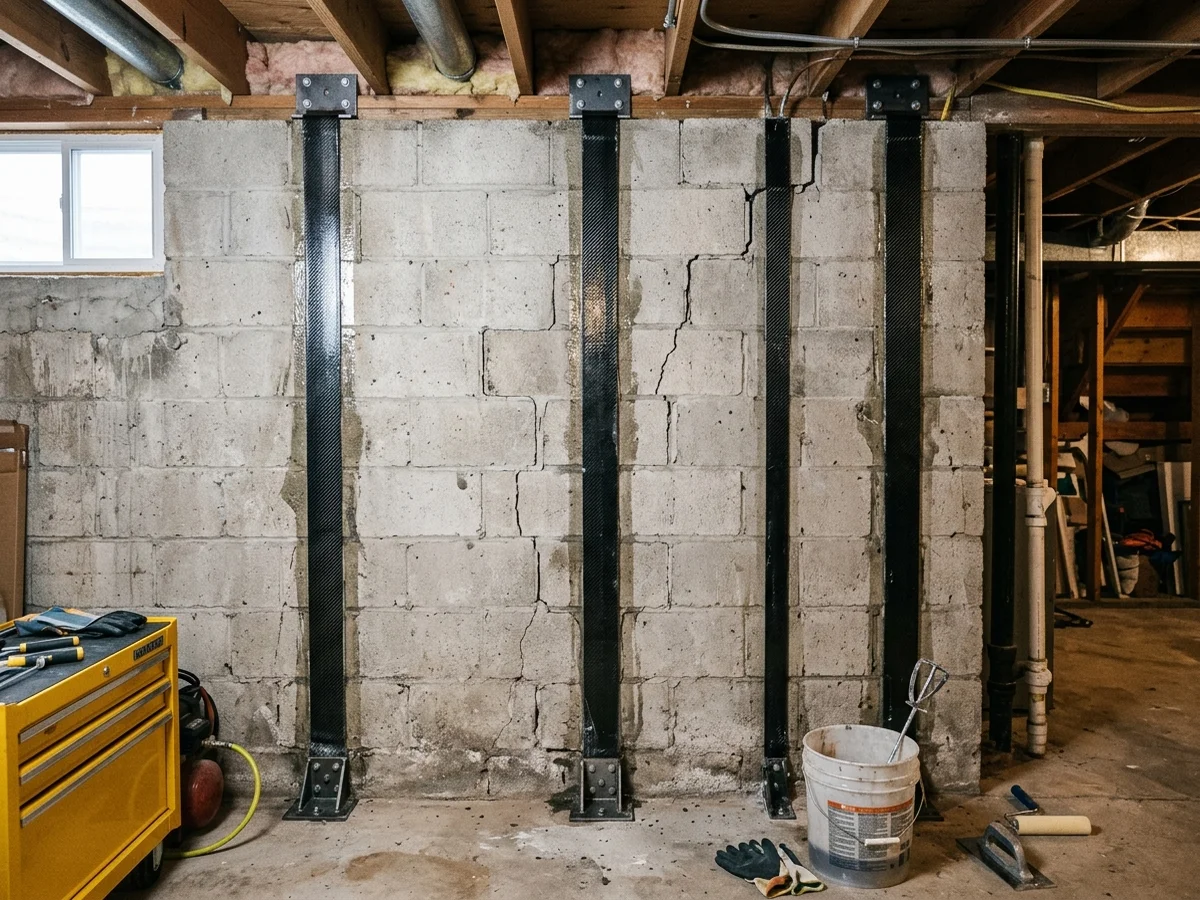
How Carbon Fiber Restores Tensile Strength to Foundation Walls
Concrete and masonry blocks are exceptionally strong under compressive loads (downward house weight), but weak under tensile forces (inward bending). When wet soil pushes against your basement wall, the inside face stretches and cracks. Carbon fiber solves the physics of wall failure.
Extreme Tensile Capacity
With a tensile strength exceeding 300,000 psi, carbon fiber is roughly 10 times stronger than structural steel. It does not stretch or yield, preventing the wall from flexing further inward.
Inseparable Epoxy Matrix
High-modulus structural epoxy saturates the carbon weave, bonding deeply into the concrete substrate. The bond strength exceeds the tensile strength of the concrete itself, creating a unified composite wall.
Total Moisture Immunity
Unlike steel beams that can rust or corrode in damp subterranean environments, carbon fiber composite is completely impervious to water, chemical exposure, and humidity.
When Is Carbon Fiber the Optimal Engineered Solution?
Carbon fiber is an ideal repair method for walls in early-to-moderate stages of lateral movement. Our structural inspection verifies whether your wall meets key engineering criteria for strap installation.
Deflection Under Two Inches
If laser measurements confirm the inward bow is less than two inches and the wall has not sheared off the footing, carbon fiber provides permanent, zero-excavation stabilization.
Zero Yard Clearance or Obstructed Exterior
When exterior porches, air conditioning units, concrete patios, or property lines make outdoor earth anchoring impossible, carbon fiber secures the foundation entirely from the inside.
Finished Basement & Living Space Priority
Because the straps sit flush against the wall face, they can be painted or framed behind standard studs without sacrificing four to six inches of perimeter floor area.
Carbon Fiber Straps vs. Wall Anchors vs. Steel I-Beams
Every foundation wall deflection scenario has specific engineering requirements. Here is how carbon fiber compares directly to alternative lateral repair systems.
Internal High-Tensile Composite Bonding
Best for inward deflection under two inches, tight property lines, zero yard excavation, and finished basements where maintaining usable square footage is a top priority.
Yard-Anchored Mechanical Straightening
Best for severe inward bowing exceeding two inches, inward tipping at the top plate, or situations where pulling the wall back toward plumb over time is desired.
Has your basement wall deflected more than two inches?
Learn how earth wall anchors use exterior soil plates to stabilize and straighten heavily bowed walls.
The Carbon Fiber Installation Process
A precise structural procedure performed entirely from inside your basement with zero exterior excavation.
Laser Deflection Survey
Our technician measures the exact inward curve of the wall with laser levels. We verify that inward deflection is under two inches and confirm whether the bottom block course has experienced shear.
Mechanical Surface Preparation
Technicians grind the interior wall face with diamond-cup wheels to remove paint, efflorescence, and surface glaze. This exposes clean concrete pore structure for optimal resin bonding.
Top Rim Joist Bracket Mounting
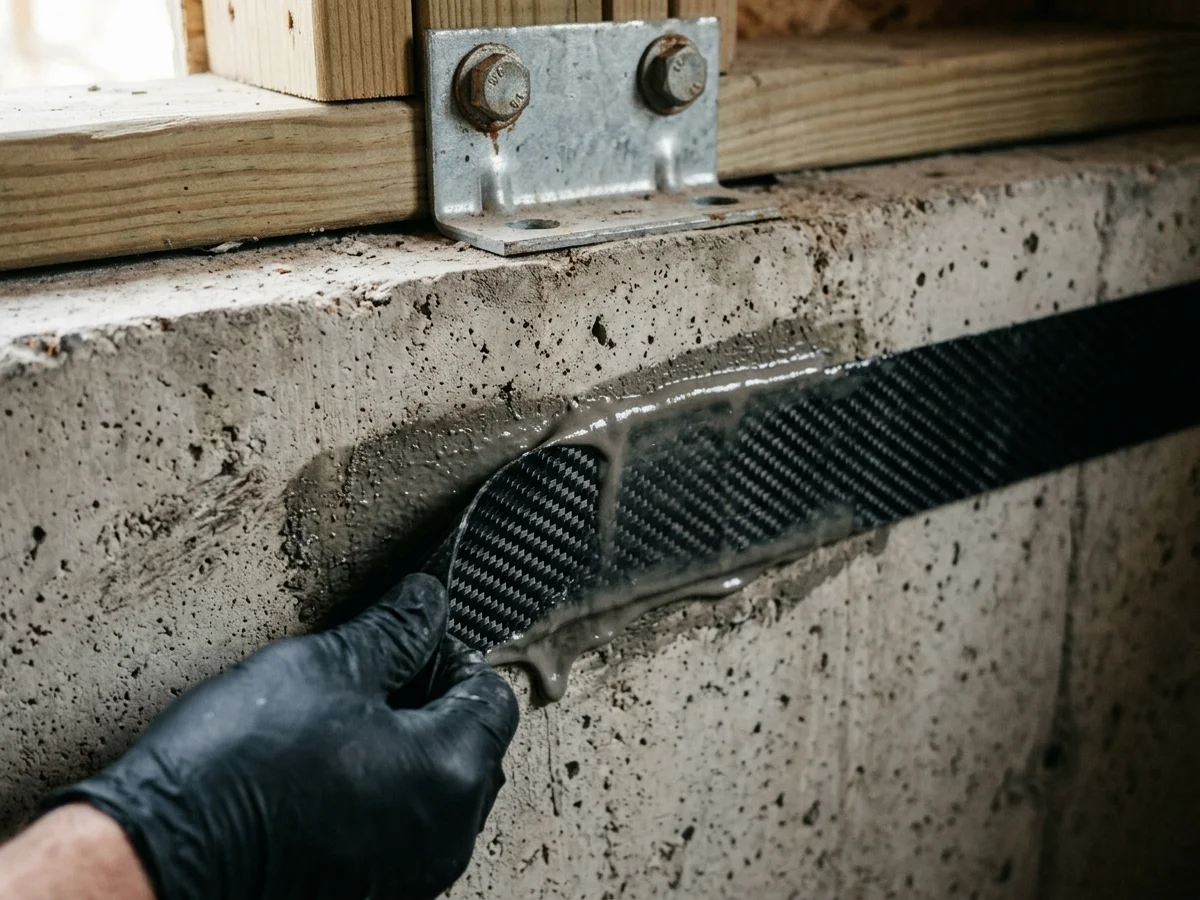
Heavy-gauge galvanized steel brackets are lag-bolted into the wooden rim joist framing and sill plate. This crucial top connection prevents inward tipping under lateral soil pressure.
Bottom Slab Anchor Placement
The lower end of each strap is tied into the concrete basement floor slab using engineered carbon fiber foot brackets or steel anchor pins. This prevents the bottom course from kicking inward.
Epoxy Matrix Saturation & Bonding
High-modulus structural epoxy paste is applied to the wall. The woven carbon fiber strap is embedded into the resin and squeegeed under tension to achieve full composite matrix integration.
Final Plumb Check & Smooth Finish
The team verifies continuous surface contact and tension. Once cured, the low-profile straps can be painted over or concealed behind standard wall framing without losing basement floor space.
Complete Basement & Foundation Wall Repair Overview
Carbon fiber straps are part of our specialized basement wall stabilization services. Explore overall wall bowing causes, hydrostatic pressure mitigation, and Middle Tennessee service areas.
Questions About Carbon Fiber Foundation Repair
Clear, factual answers regarding carbon fiber strap engineering, performance, and application.
Schedule an On-Site Basement Wall Inspection
Speak with a local foundation specialist. We will measure your wall deflection, examine fracture lines, and determine whether zero-excavation carbon fiber straps are the proper engineered solution for your home.
Serving homeowners across Middle Tennessee: